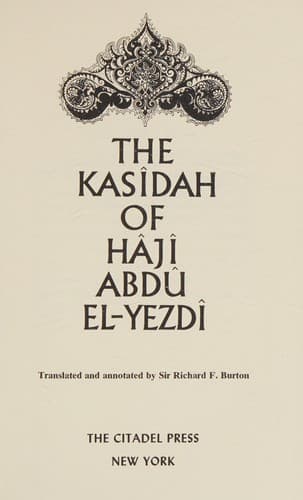
The Kasîdah of Hâjî Abdû El-YezdîBurton, Richard Francis, Sir
Philosophy
The Kasîdah of Hâjî Abdû El-Yezdî
Burton, Richard Francis, Sir
English poetry -- 19th century
The latter implies an equal capacity for pleasure, and thus the
balance is kept.
Hâjî Abdû then proceeds to show that Faith is an accident of
birth. One of his omitted distichs says:
Race makes religion; true! but aye
upon the Maker acts the made,
A finite God, and infinite sin,
in lieu of raising man, degrade.
In a manner of dialogue he introduces the various races each
fighting to establish its own belief. The Frank (Christian)
abuses the Hindu, who retorts that he is of Mlenchha, mixed or
impure, blood, a term applied to all non-Hindus. The same is done
by Nazarene and Mohammedan; by the Confucian, who believes in
nothing, and by the Soofi, who naturally has the last word. The
association of the Virgin Mary and St. Joseph with the Trinity,
in the Roman and Greek Churches, makes many Moslems conclude that
Christians believe not in three but in five Persons. So an
Englishman writes of the early Fathers, They not only said that
3 = 1, and that 1 = 3: they professed to explain how that curious
arithmetical combination had been brought about. The Indivisible
had been divided, and yet was not divided: it was divisible, and
yet it was indivisible; black was white and white was black; and
yet there were not two colours but one colour; and whoever did
not believe it would be damned. The Arab quotation runs in the
original:
_Ahsanu l-Makâni l il-Fatâ l-Jehannamu_
The best of places for (the generous) youth is Gehenna.
Gehenna, alias Jahim, being the fiery place of eternal
punishment. And the second saying, _Al- nâr wa lâ l-Ar_Fire
(of Hell) rather than Shame,is equally condemned by the
Koranist. The Gustâkhi (insolence) of Fate is the expression of
Umar-i-Khayyam (St. xxx):
What, without asking hither hurried _whence?_
And, without asking _whither_ hurried hence!
Oh many a cup of this forbidden wine
Must drown the memory of that insolence.
Soofistically, the word means the coquetry of the beloved one,
the divinæ particula auræ. And the section ends with Popes:
He cant be wrong whose life is in the right.
CONCLUSION
Here the Hâjî ends his practical study of mankind. The image of
Destiny playing with men as pieces is a view common amongst
Easterns. His idea of wisdom is once more Popes:
And all our knowledge is ourselves to know.
(Essay IV. 398.)
Public-domain text, read in full here on John Shaqi.
Reviews
Reviews
No reviews yet
Be the first to share your thoughts on this work.
Join the Discussion
Join the discussion
Sign in to leave a comment or review.
Sign InorCreate an account