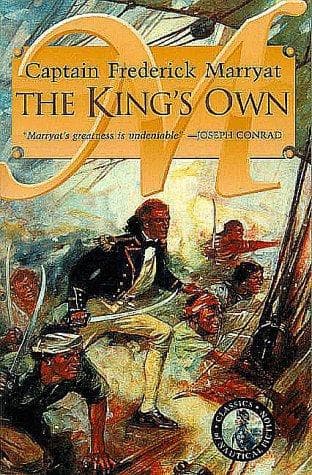
Great Britain -- History, Naval -- 18th century -- Fiction; Nore Mutiny, 1797 -- Fiction
The prize being now ready, Captain M--- desired Courtenay to take charge
of it, and select two of the midshipmen to accompany him. His choice
fell upon Seymour and Jerry: the latter being selected rather for his
own amusement, than for his qualities as an officer. The distance to
Jamaica, to which island he was directed to proceed, and from thence
with his crew to obtain a passage to Barbadoes, was not great, and
Captain M--- did not like to have the frigate short manned; he was
therefore not allowed to take more than ten seamen with him, five
prisoners being sent on board, to assist in navigating the vessel. Mr
Capon and Mr Contract, at their own request, went as passengers.
In the afternoon, as soon as the provisions were on board, Courtenay
received his written orders, and in a few hours the frigate was out of
sight. They had barely time to stow away everything in its place, and
make the necessary arrangements, when a heavy North East swell, and
lowering horizon, predicted a continuance of the fair wind, and plenty
of it. So it proved; the wind increased rapidly, and the men found it
difficult to reduce the canvas in sufficient time. Before dark, the
wind blew with considerable force, not steadily, but in fitful gusts:
and the sun, as he descended in the wave, warned them, by his red and
fiery aspect, to prepare for an increase of the gale. The schooner flew
before it, under her diminished sail, rolling gunwale-to in the deep
trough, or lurching heavily as her weather quarter was borne up aloft by
the culminating swell. All was secured for the night; the watch was
set, and Seymour walked the deck, while Courtenay and the rest went
below, and at an early hour retired to their beds.
Among other reasons for selecting our hero as one of his assistants,
Courtenay was influenced by his perfect knowledge of the French
language, which might prove useful in communicating with the French
prisoners, who were sent on board to assist in working the vessel.
Jerry had also boasted of his talent in that way, as he wished to go in
the prize; and, although the reader, from the specimen which he has had,
may not exactly give credit to his assertions, yet Courtenay, who had
never heard him, believed that he was pretty well acquainted with the
language.
But, soon after they had parted with the frigate, when Courtenay desired
the French prisoners to lay hold of the ropes and assist in shortening
sail, they all refused. Seymour was not on deck at the time; he had
been desired to superintend the arrangements below: and although he had
been informed of their conduct, he had not yet spoken to the prisoners.
Two of them were sitting aft under the lee of the weather-bulwark, as
Seymour was walking the deck to and fro. They were in earnest
conversation, when Seymour stopped near to them, carelessly leaning over
the weather-quarter, watching the long following seas, when he overheard
one say to the other--
"_Taisez, peut-etre qu'il nous entend_."
Public-domain text, read in full here on John Shaqi.
Reviews
Reviews
No reviews yet
Be the first to share your thoughts on this work.
Elsewhere in the archive
Join the Discussion
Join the discussion
Sign in to leave a comment or review.
Sign InorCreate an account