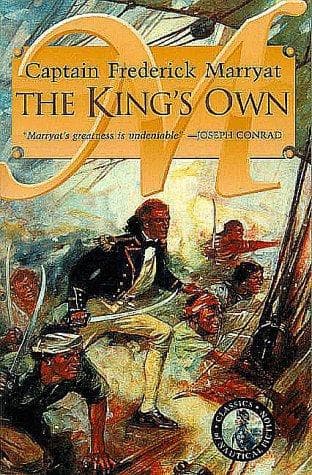
Great Britain -- History, Naval -- 18th century -- Fiction; Nore Mutiny, 1797 -- Fiction
"Blue Cap, Blue Cap."
"You lie, sir."
"Who, then, sir?"
"Yellow Cap, Yellow Cap."
Yellow Cap unfortunately did not give the lie in time, for which he was
severely punished, and the game then continued.
But the part of the game which created the most mirth was providing a
goose for the tailors, which was accomplished by some of their
confederates throwing into the circle any bystander who was not on his
guard, and who, immediately that he was thrown in, was thrashed and
kicked by the whole circle until he could make his escape. An attempt
of this kind was soon made upon Seymour, who, being well acquainted with
the game, and perceiving the party rushing on him to push him in,
dropped on his hands and knees, so that the other was caught in his own
trap, by tumbling over Seymour into the circle himself; from which he at
last escaped, as much mortified by the laugh raised against him as with
the blows which he had received.
Seymour, who was ready to join in any fun, applied for work, and was
admitted among the journeymen.
"What's your name?"
"Dandy Grey Russet Cap," replied Seymour, selecting a colour which would
give him ample time for answering to his call.
"Oh, I'll be damned but you're an old hand," observed one of the party,
and the game continued with as much noise as ever.
But we must leave it, and return to Mr Skrimmage, who was a singular,
if not solitary instance of a person in one of the lowest grades of the
service having amassed a large fortune. He had served his time under an
attorney, and from that situation, why or wherefore the deponent sayeth
not, shipped on board a man-of-war in the capacity of a ship's clerk.
The vessel which first received him on board was an old fifty-gun ship
of two decks, a few of which remained in the service at that time,
although they have long been dismissed and broken up. Being a dull
sailer, and fit for nothing else, she was constantly employed in
protecting large convoys of merchant vessels to America and the West
Indies. Although other men-of-war occasionally assisted her in her
employ, the captain of the fifty-gun ship, from long standing, was
invariably the senior officer, and the masters of the merchant vessels
were obliged to go on board his ship to receive their convoy
instructions, and a distinguishing pennant, which is always given
without any fee.
But Skrimmage, who had never been accustomed to deliver up any paper
without a fee when he was in his former profession, did not feel
inclined to do so in his present. Make a direct charge he dare not--he,
therefore, hit upon a _ruse de guerre_ which effected his purpose. He
borrowed from different parties seven or eight guineas, and when the
masters of merchant vessels came on board for their instructions, he
desired them to be shown down into his cabin, where he received them
with great formality and very nicely dressed. The guineas were spread
upon the desk, so that they might be easily reckoned.
Public-domain text, read in full here on John Shaqi.
Reviews
Reviews
No reviews yet
Be the first to share your thoughts on this work.
Elsewhere in the archive
Join the Discussion
Join the discussion
Sign in to leave a comment or review.
Sign InorCreate an account