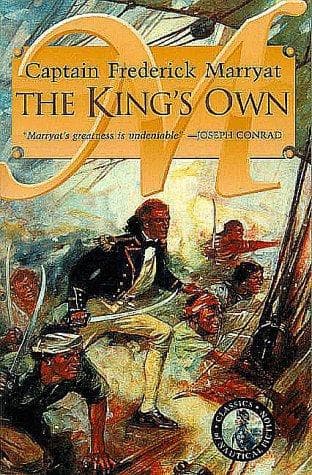
Great Britain -- History, Naval -- 18th century -- Fiction; Nore Mutiny, 1797 -- Fiction
There is, perhaps, no quality in man partaking of such variety, and so
difficult to analyse, as _courage_, whether it be physical or mental,
both of which are not only innate, but to be acquired. The former, and
the most universal, is most capriciously bestowed; sometimes, although
rarely, Nature has denied it altogether. We have, therefore, in the
latter instance, courage nil as a zero, courage negative, halfway up,
and courage positive, at the top, which may be considered as "blood
heat;" and upon this thermometrical scale the animal courage of every
individual may be placed. Courage _nil_ or cowardice, needs no
explanation. Courage negative, which is the most common, is that degree
of firmness which will enable a person to do his duty when danger _comes
to him_; he will not avoid danger, but he will not exactly seek it.
Courage positive, when implanted in a man, will induce him to seek
danger, and find opportunities of distinguishing himself where others
can see none. Courage negative is a passive feeling, and requires to be
roused. Courage positive is an active and restless feeling, always on
the look-out.
An extreme susceptibility, and a phlegmatic indifference of disposition,
although diametrically in opposition to each other, will produce the
same results: in the former, it is mental, in the latter, animal
courage. Paradoxical as it may appear, the most certain and most
valuable description of _courage_ is that which is acquired from the
_fear of shame_. Further, there is no talent which returns more fold
than courage, when constantly in exercise: for habit will soon raise the
individual, whose index is near to zero, to the degree in the scale
opposite to courage negative; and the possessor of courage negative will
rise up to that of courage positive; although, from desuetude, they
_will again sink to their former position_.
Public-domain text, read in full here on John Shaqi.
Reviews
Reviews
No reviews yet
Be the first to share your thoughts on this work.
Elsewhere in the archive
Join the Discussion
Join the discussion
Sign in to leave a comment or review.
Sign InorCreate an account