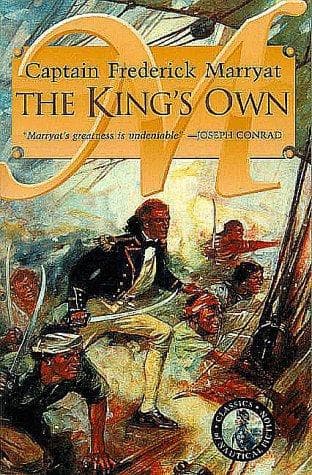
Great Britain -- History, Naval -- 18th century -- Fiction; Nore Mutiny, 1797 -- Fiction
It may, then, be inquired, why he requested to be employed during the
war? Because he liked full pay and prize-money when it could be
obtained without risk, and because his wife and family were living on
shore in a very snug little cottage at Ryde, in the Isle of Wight, which
cottage required nothing but furniture and a few other trifles to render
it complete. Marriage had not only subtracted from the courage of this
worthy officer, but, moreover, a little from his honesty. Captain
Capperbar (for such was his name) should have been brought up as a
missionary, for he could _canvert_ anything, and _expend_ more profusely
than any Bible Society. The name by which he had christened his
domicile was probably given as a sort of salvo to his conscience. He
called it the "_Ship_;" and when he signed his name to the expense books
of the different warrant officers, without specifying the exact use to
which the materials were applied, the larger proportions were invariably
expended, by the general term, for "_Ship's_ use." He came into harbour
as often as he could, always had a demand for stores to complete, and a
defect or two for the dockyard to make good, and the admiral, who was
aware of Mr Capperbar being a near resident, made every reasonable
allowance for his partiality to Spithead. But we had better introduce
the captain, sitting at his table in the fore-cabin, on the day of his
arrival in port, the carpenter having obeyed his summons.
"Well, Mr Cheeks, what are the carpenters about?"
"Weston and Smallbridge are going on with the chairs--the whole of them
will be finished tomorrow."
"Well?"
"Smith is about the chest of drawers, to match the one in my Lady
Capperbar's bed-room."
"Very good. And what is Hilton about?"
"He has finished the spare-leaf of the dining-table, sir; he is now
about a little job for the second-lieutenant."
"A job for the second-lieutenant, sir? How often have I told you, Mr
Cheeks, that the carpenters are not to be employed, except on ship's
duty, without my special permission."
"His standing bed-place is broke, sir; he is only getting out a chock or
two."
"Mr Cheeks, you have disobeyed my most positive orders.--By the bye,
sir, I understand you were not sober last night."
"Please your honour," replied the carpenter, "I wasn't drunk--I was only
a little fresh."
"Take you care, Mr Cheeks. Well, now, what are the rest of your crew
about?"
"Why, Thompson and Waters are cutting out the pales for the garden, out
of the jib-booms; I've saved the heel to return."
"Very well, but there won't be enough, will there?"
"No, sir, it will take a hand-mast to finish the whole."
"Then we must expend one when we go out again. We can carry away a
topmast, and make a new one out of the hand-mast at sea. In the
meantime, if the sawyers have nothing to do, they may as well cut the
palings at once. And now, let me see--oh! the painters must go on
shore, to finish the attics."
Public-domain text, read in full here on John Shaqi.
Reviews
Reviews
No reviews yet
Be the first to share your thoughts on this work.
Elsewhere in the archive
Join the Discussion
Join the discussion
Sign in to leave a comment or review.
Sign InorCreate an account