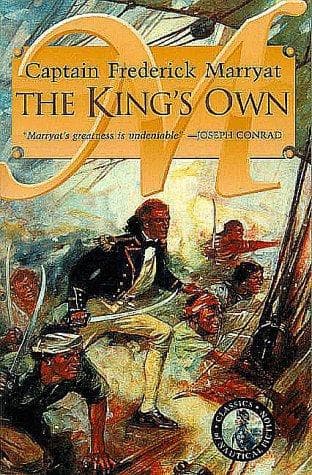
Great Britain -- History, Naval -- 18th century -- Fiction; Nore Mutiny, 1797 -- Fiction
Seymour covered his face with his hands, as he leant over the table. He
had no secrets from McElvina, and acknowledged the truth of the
observation. "I have brought up the subject, my dear boy," continued
McElvina, "because I have not been blind, and I am afraid that you will
cherish a feeling which can only end in disappointment. She is a sweet
girl; but you must, if possible, forget her. Reflect a moment. You are
an orphan, without money and without family, although not without
friends, which you have secured by your own merit; and you have only
your courage and your abilities to advance you in the service. Can it,
then, be expected, that her parents would consent to an union--or would
it be honourable in you to take any advantage of her youthful
prepossession in your favour, and prevent her from reaping those
advantages that her fortune and family entitle her to?"
Seymour felt bitterly the justice of the remark; a few tears trickled
through his fingers, but his mind was resolved. He had thought to have
declared his love before his departure, and have obtained an
acknowledgment on her part; but he now made a firm resolution to avoid
and to forget her. "I shall follow your advice, my dear sir, for it is
that of a friend who is careful of my honour; but if you knew the state
of mind that I am in!--How foolish and inconsiderate have I been!--I
will not see her again."
"Nay, that would be acting wrongly; it would be quite unpardonable,
after the kindness which you have received from Mrs Rainscourt, not to
call and wish them farewell. You must do it, Seymour. It will be an
exertion, I acknowledge; but, if I mistake not his character, not too
great a one for William Seymour. Good night, my dear boy."
On the ensuing morning, Seymour, who had fortified himself in his good
resolutions, walked to the hall to announce his approaching departure on
foreign service, and to take his farewell, his last farewell, of Emily.
He found the carriage at the door, and Mrs Rainscourt in her pelisse
and bonnet, about to pay a visit at some distance. She was sorry at the
information, for Seymour was a great favourite, and delayed her
departure for a quarter of an hour to converse with him; at the end of
which, Emily, who had been walking, came into the library.
Communicating the intelligence to her daughter, Mrs Rainscourt then
bade him farewell, and expressing many wishes for his health and
happiness, was handed by him into the carriage, and drove off; leaving
Seymour to return to the library, and find himself--the very position he
had wished to avoid--alone with Emily.
Public-domain text, read in full here on John Shaqi.
Reviews
Reviews
No reviews yet
Be the first to share your thoughts on this work.
Elsewhere in the archive
Join the Discussion
Join the discussion
Sign in to leave a comment or review.
Sign InorCreate an account