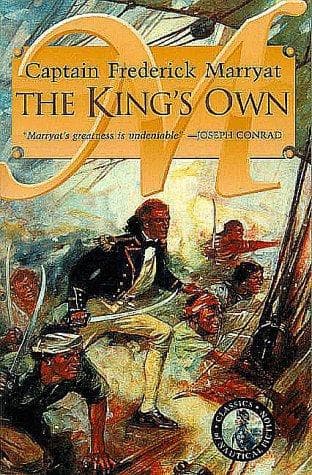
Great Britain -- History, Naval -- 18th century -- Fiction; Nore Mutiny, 1797 -- Fiction
And now that she is afloat, I must candidly acknowledge that I am not
exactly pleased with her. To speak technically, her figure-head is not
thrown out enough. To translate this observation into plain English, I
find, on turning over the different chapters, that my hero, as I have
often designated him, is not sufficiently the hero of my tale. As soon
as he is shipped on board of a man-of-war, he becomes as insignificant
as a midshipman must unavoidably be, from his humble situation. I see
the error--yet I cannot correct it, without overthrowing all "rules and
regulations," which I cannot persuade myself to do, even in a work of
fiction. Trammelled as I am by "the service," I can only plead guilty
to what it is impossible to amend without commencing _de novo_--for
everything and everybody must find their level on board of a king's
ship. Well, I've one comfort left--Sir Walter Scott has never succeeded
in making a hero; or, in other words, his best characters are not those
which commonly go under the designation of "the hero." I am afraid
there is something irreclaimably insipid in these _preux chevaliers_.
But I must go in search of the _Aspasia_. There she is, with
studding-sails set, about fifty miles to the northward of the Cape of
Good Hope; and I think that when the reader has finished this chapter,
he will be inclined to surmise that the author, as well as the
_Aspasia_, has most decidedly "doubled the Cape." The frigate was
standing her course before a light breeze, at the rate of four or five
knots an hour, and Captain M--- was standing at the break of the
gangway, talking with the first-lieutenant, when the man stationed at
the mast-head called out, "A rock on the lee-bow!" The Telemaque shoal,
which is supposed to exist somewhere to the southward of the Cape, but
whose situation has never been ascertained, had just before been the
subject of their conversation. Startled at the intelligence, Captain
M--- ordered the studding-sails to be taken in, and, hailing the man at
the mast-head, inquired how far the rock was distant from the ship.
"I can see it off the fore-yard," answered Pearce, the master, who had
immediately ascended the rigging upon the report.
The first-lieutenant now went aloft, and soon brought it down to the
lower ratlines. In a few minutes it was distinctly seen from the deck
of the frigate.
The ship's course was altered three or four points, that no risk might
be incurred; and Captain M---, directing the people aloft to keep a
sharp look-out for any change in the colour of the water, continued to
near the supposed danger in a slanting direction.
Public-domain text, read in full here on John Shaqi.
Reviews
Reviews
No reviews yet
Be the first to share your thoughts on this work.
Elsewhere in the archive
Join the Discussion
Join the discussion
Sign in to leave a comment or review.
Sign InorCreate an account