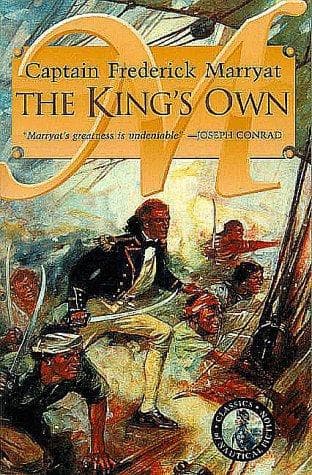
Great Britain -- History, Naval -- 18th century -- Fiction; Nore Mutiny, 1797 -- Fiction
The promise being given, the vicar commenced with the history of Admiral
de Courcy,--his treatment of his wife and children,--the unfortunate
marriage, and more unfortunate demise of Edward Peters, or rather of
Edward de Courcy--the acknowledgment of his grandson by Admiral de
Courcy on his death-bed--the account of Adams--his death--the boy being
sent away in a prize, and drowned at sea. "I have all the particulars
in writing," continued the good man, "and the necessary documents; and
his identity was easy to be proved by the mark of the broad-arrow
imprinted on his shoulder by old Adams."
"Heavens! is it possible?" exclaimed McElvina, grasping the arm of the
vicar.
"What do you mean?"
"Mean!--I mean that the boy is alive--has been in your company within
the last two years."
"That boy?"
"Yes, that boy--that boy is William Seymour."
"Merciful God! how inscrutable are thy ways!" exclaimed the vicar with
astonishment and reverence. "Explain to me, my dear sir,--how can you
establish your assertion?"
If the reader will refer back to the circumstance of the vicar calling
upon Captain M---, he will observe that, upon being made acquainted with
the loss of the child, he was so much shocked that he withdrew without
imparting the particulars to one who was a perfect stranger; and, on the
other hand, Captain M---, when Seymour again made his appearance, after
an interval of three years, not having been put in possession of these
facts, or even knowing the vicar's address or name, had no means of
communicating the intelligence of the boy's recovery.
"I must now, sir," said McElvina to the vicar, "return the confidence
which you have placed in me, under the same promise of secrecy, by
making you acquainted with some particulars of my former life, at which
I acknowledge I have reason to blush, and which nothing but the
interests of William Seymour would have induced me to disclose."
McElvina then acknowledged his having formerly been engaged in
smuggling--his picking up the boy from the wreck--his care of him for
three years--the capture of his vessel by Captain M---, and the
circumstances that had induced Captain M--- to take the boy under his
protection. The mark was as legible as ever, and there could be no
doubt of his identity being satisfactorily established.
The vicar listened to the narration with the interest which it deserved,
and acknowledged his conviction of the clearness of the evidence, by
observing--
"This will be a heavy blow to our dear Emily."
"Not a very heavy one, I imagine," replied McElvina, who immediately
relieved the mind of the worthy man by communicating the attachment
between them, and the honourable behaviour of Seymour.
"How very strange this is!" replied the vicar. "It really would be a
good subject for a novel. I only trust that, like all inventions of the
kind, it may end as happily."
"I trust so too; but let us now consider what must be done."
"I should advise his being sent for immediately."
Public-domain text, read in full here on John Shaqi.
Reviews
Reviews
No reviews yet
Be the first to share your thoughts on this work.
Elsewhere in the archive
Join the Discussion
Join the discussion
Sign in to leave a comment or review.
Sign InorCreate an account