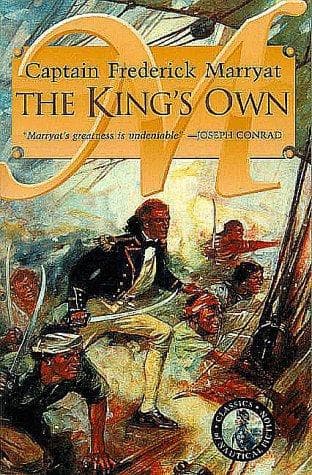
Great Britain -- History, Naval -- 18th century -- Fiction; Nore Mutiny, 1797 -- Fiction
The shock threw the men off their feet as they raised an appealing cry
to Heaven, which was mocked by the howling of the wind and the roar of
the waters. The masts, which were thrown out from their steps, waved
once, twice, and then fell over the sides with a crash, as an enormous
sea broke over the vessel, forcing her further on the rocks, and causing
every timber and knee in her to start from its place. The masts, as
they fell, and the sea, that at the same moment poured over like an
impetuous cataract, swept away thirty or forty of the seamen into the
boiling element under the lee. Another and another shock from the
resistless and furious waves decided the fate of the resolute captain
and master. The frigate parted amidships. The fore part of her, which
was firmly wedged on the rocks, remained. The quarter-deck and
after-part turned over to the deep water, and disappeared. An enormous
surge curled over it as it went down, and, as if disappointed at not
being able to wreak its fury upon that part of the vessel, which, by
sinking, had evaded it, it drove in revenge upon the remainder, forcing
it several yards higher upon the reef.
Two-thirds of the ship's company were now gone--the captain, the master,
and the major part of the officers and men, being on the quarter-deck
when the ship divided. The cry of the drowning was not heard amidst the
roaring of the elements. The behaviour of the captain and the officers
at this dreadful crisis has not been handed down; but, if we may judge
from what has already been narrated, they met their fate like British
seamen.
The fore part of the ship still held together, and, fortunately for the
survivors, heeled towards the land, so as to afford some protection from
the force of the seas, which dashed over it at each succeeding swell of
the billows. Daylight left them, and darkness added to the despair and
horror of nearly one hundred wretches, who felt, at each shock which
threatened to separate the planks and timbers, as if death was loudly
knocking to claim the residue of his destined victims. Not one word was
exchanged; but, secured with ropes to the belaying-pins, and other parts
of the forecastle where they could pass their lashings, they clung and
huddled together, either absorbed in meditation or wailing with despair.
Occasionally, one who had supported himself in a difficult and painful
position, stimulated with the faint hopes of life, to which we all so
fondly and so foolishly cling, would find that his strength was
exhausted, and that he could hold no longer. After vainly imploring
those near him to allow him to better his condition by a slight personal
sacrifice on their part (an appeal that received no answer), he would
gradually loose his hold, and drop into the surge that was commissioned
by death to receive his prey.
Public-domain text, read in full here on John Shaqi.
Reviews
Reviews
No reviews yet
Be the first to share your thoughts on this work.
Elsewhere in the archive
Join the Discussion
Join the discussion
Sign in to leave a comment or review.
Sign InorCreate an account