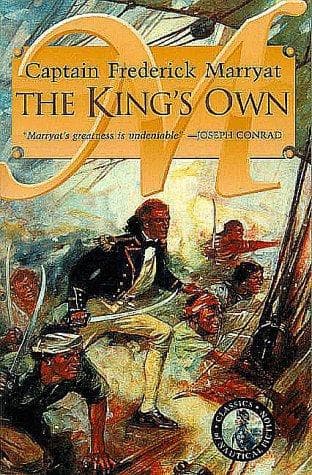
Great Britain -- History, Naval -- 18th century -- Fiction; Nore Mutiny, 1797 -- Fiction
The admiral listened to the recital of the vicar without interruption,
and, as soon as it was finished, to the great joy of the worthy pastor,
expressed the most anxious wish to make every reparation in his power.
Aware that difficulties might arise, from the circumstance of our hero's
existence not being suspected by his collateral heirs, who had for some
time considered as certain their ultimate possession of his large
entailed property, he directed a will to be immediately drawn up,
acknowledging his grandchild, and leaving to him all his personal
property, which was very considerable; and praying the vicar to take
upon himself the office of guardian to the boy--a request which was
cheerfully complied with. The admiral would not listen to the repeated
requests of the vicar, to take the repose which his excited and sinking
frame required, until the necessary document had been drawn out, signed,
and duly witnessed. When all was complete he fell back on the pillow,
in such a state of exhaustion as threatened immediately to terminate his
career. It was late when the vicar took his leave, after having
administered some little consolation to the repentant and dying man, and
promised to call upon him early on the ensuing morning.
But the vicar had other duties to perform, which induced him to defer
his visit until the following noon. Others were sick, others were
dying, and needed spiritual consolation; and he made no distinction
between the rich and the poor. The physicians had expressed their
opinion that the admiral might linger for many days, and the vicar
thought that advantage might be derived from his being left for a short
time to his own reflections, and to recover from the state of exhaustion
arising from the communications of the preceding evening. When he
arrived at the hall the windows were closed--Admiral De Courcy was no
more.
Reader, you shall hear how he died. It was about two o'clock in the
morning that he awoke from an uneasy slumber, and felt his end
approaching. The old crone who had been hired as a nurse to watch at
night, was fast asleep in her chair. The rushlight had burned low down
in the socket, and, through the interstices of its pierced shade, threw
a feeble and alternate light and shadow over the room. The mouth of the
dying man was glued together from internal heat, and he suffered from
agonising thirst. He murmured for relief, but no one answered. Again
and again he attempted to make his careless attendant acquainted with
his wants, but in vain. He stretched out his arm and moved the curtains
of the bed, that the noise of the curtain-rings upon the iron rods might
have the effect, and then fell back with exhaustion, arising from the
effort which he had made.
Public-domain text, read in full here on John Shaqi.
Reviews
Reviews
No reviews yet
Be the first to share your thoughts on this work.
Elsewhere in the archive
Join the Discussion
Join the discussion
Sign in to leave a comment or review.
Sign InorCreate an account