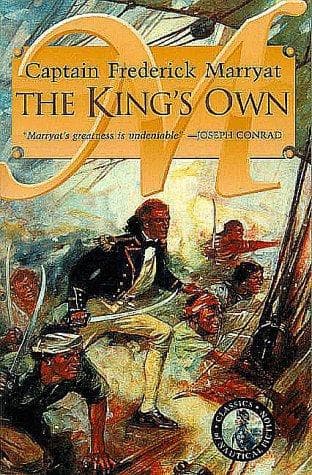
Great Britain -- History, Naval -- 18th century -- Fiction; Nore Mutiny, 1797 -- Fiction
This decided the point as to his escape through the passage, which he
had made his utmost exertions to effect, in pursuance of the peremptory
orders which he had received. He now hauled his wind on the same tack
as the _Aspasia_, pouring in his starboard broadside as he rounded-to.
The manoeuvre was good, as he thereby retained his weather-gage--and the
wreck of his top-mast having fallen over his larboard side, he had his
starboard broadside, which was all clear, and directed towards his
opponent; moreover, he forced the _Aspasia_ to follow him into the bay
formed between the Bec du Raz and the Bec du Chevre, where she would in
all probability receive considerable damage from the batteries which
lined the coast.
Captain M--- was aware of all this; but his only fear was that his enemy
should run on shore, and prevent his carrying him into port. The
_Aspasia_ was soon abreast of her opponent, and their broadsides were
exchanged, when Captain M---, who wished to bring the action to a speedy
conclusion, shot his vessel ahead, which he was enabled to do, from his
superiority of sailing, after the main-topmast of the French frigate had
been shot away. It was his intention not to have tacked until he could
have fetched his antagonist, but the galling fire of the batteries,
which now hulled him every time, induced him to go about, and, as he was
in stays, a raking shot entered the cabin windows, and, in its passage
along the main-deck, added ten men to his list of killed and wounded.
Again the frigates, on opposite tacks, poured in their broadsides--the
fore-yard of the Frenchman was divided in the slings, and fell, hanging
by the topsail sheets and lifts, and tearing the sails, which fell over
the forecastle guns, and caught fire as they were discharged at the same
moment. Nor did the _Aspasia_ suffer less, for her mizen-topmast was
shot through, and her starboard anchor, cut from her bows, fell under
her bottom and tore away the cable (a short range of which Captain
M--- had had the precaution to have on deck, as they fought so close in
shore). This threw the men at the guns into confusion, and brought the
ship up in the wind. The cable was at last separated, and flew out of
the hawse-hole after the anchor, which plunged to the bottom but this
was not effected, until, like an enormous serpent, it had enfolded in
its embraces three or four hapless men, who were carried with dreadful
velocity to the hawse-hole, where their crushed bodies for a time
stopped it from running out, and gave their shipmates an opportunity of
dividing it with their axes.
Public-domain text, read in full here on John Shaqi.
Reviews
Reviews
No reviews yet
Be the first to share your thoughts on this work.
Elsewhere in the archive
Join the Discussion
Join the discussion
Sign in to leave a comment or review.
Sign InorCreate an account