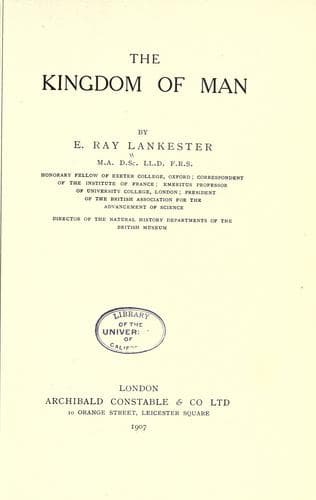
The Kingdom of ManLankester, E. Ray (Edwin Ray), Sir
History
The Kingdom of Man
Lankester, E. Ray (Edwin Ray), Sir
African trypanosomiasis; Human beings; Science -- History
A good instance of this is seen in the history of the coffee
plantations of Ceylon, where a previously rare and obscure parasitic
fungus, leading an uneventful life in the tropical forests of that
country, suddenly found itself provided with an unlimited field
of growth and exuberance in the coffee plantations. The coffee
plantations were destroyed by this parasite, which has now returned
to its pristine obscurity. Disharmonious, blundering man was
responsible for its brief triumph and celebrity. Dame Nature had not
allowed the coffee fungus more than a very moderate scope. Man comes
in and takes the reins; disaster follows; and there is no possibility
of return to the old régime. Man must make his blunders and retrieve
them by further interference--by the full use of his intelligence, by
the continually increasing ingenuity of his control of the physical
world, which he has ventured to wrest from the old rule of natural
selection and adaptation.
The adjustment of all living things to their proper environment
is one of great delicacy and often of surprising limitation. In
no living things is this more remarkable than in parasites. The
relation of a parasite to the “host” or “hosts” in which it can
flourish (often the host is only one special species or even variety
of plant or animal) is illustrated by the more familiar restriction
of certain plants to a particular soil. Thus the Cornish heath only
grows on soil overlying the chemically peculiar serpentine rocks
of Cornwall. The two common parasitic tape-worms of man pass their
early life the one in the pig and the other in bovine animals. But
that which requires the pig as its first host (_Tænia solium_) cannot
use a bovine animal as a substitute; nor can the other (_Tænia
mediocanellata_) exist in a pig. Yet the difference of porcine and
bovine flesh and juices is not a very patent one; it is one of small
variations in highly complex organic chemical substances. A big
earth-worm-like stomach-worm flourishes in man, and another kind
similar to it in the horse. But that frequenting man cannot exist in
the horse, nor that of the horse in man. Simpler parasites, such as
are the moulds, bacteria, and again the blood-parasites, trypanosoma,
etc., exhibit absolute restrictions as to the hosts in which they can
or can not flourish without showing specific changes in their vital
processes. Being far simpler in structure than the parasitic worms,
they have less “mechanism” at their disposal for bringing about
adjustment to varied conditions of life. The microscopic parasites
do not submit to alterations in the chemical character of their
surroundings without themselves reacting and showing changed chemical
activities. A change of soil (that is to say of host) may destroy
them; but, on the other hand, it may lead to increased vigour and the
most unexpected reaction on their part in the production of virulent
chemical poisons.
Public-domain text, read in full here on John Shaqi.
Reviews
Reviews
No reviews yet
Be the first to share your thoughts on this work.
Elsewhere in the archive
Join the Discussion
Join the discussion
Sign in to leave a comment or review.
Sign InorCreate an account