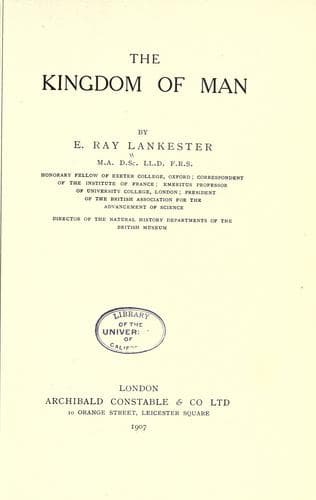
The Kingdom of ManLankester, E. Ray (Edwin Ray), Sir
History
The Kingdom of Man
Lankester, E. Ray (Edwin Ray), Sir
African trypanosomiasis; Human beings; Science -- History
[9] This has been established in the case of the _Trypanosoma
Brucei_, a minute parasite living in the blood of big game
in south-east Africa, amongst which it is disseminated by a
blood-sucking fly, the _Glossina morsitans_ or Tsetze fly. The
parasite appears to do little or no harm to the native big game, but
causes a deadly disease both in the horses and cattle introduced by
Europeans and in the more anciently introduced native cattle (of
Indian origin). Similar cases are found where a disease germ (such
as that of measles) produces but a small degree of sickness and
mortality in a population long associated with it, but is deadly to
a human community to which it is a new-comer. Thus Europeans have
introduced measles with deadly results in the South Sea Islands. A
similar kind of difficulty, of which many might be cited, is brought
about by man’s importations and exportations of useful plants. He
thus brought the Phylloxera to Europe, not realizing before hand
that this little parasitic bug, though harmless to the American
vine, which puts out new shoots on its roots when the insect injures
the old ones, is absolutely deadly to the European vine, which
has not acquired the simple but all-important mode of growth by
which the American vine is rendered safe. Thus, too, he took the
coffee-plant to Ceylon, and found his plantations suddenly devastated
by a minute mould, the _Himileia vastatrix_, which had lived very
innocently before that in the Cingalese forests, but was ready to
burst into rapacious and destructive activity when the new unadjusted
coffee-trees were imported by man and presented in carefully crowded
plantations to its unrestrained infection.
[10] The phosphorescent disease of the sand-hopper (_Talitrus_) is
described by Giard and Billet in a paper entitled ‘Observations
sur la maladie phosphorescente des Talitres et autres Crustacés,’
in the memoirs of the Société de Biologie, Oct. 19, 1889. Billet
subsequently gave a further account of this organism, and named
it _Bacillus Giardi_--after Professor Giard of Paris. (Bulletins
scientifiques de la France et de la Belgique, xxi. 1898, p. 144).
It appears that the parasite is transmitted from one individual to
another in coition. The specimens studied by Giard and Billet were
obtained at Wimereux near Boulogne. I found the disease very abundant
at Ouistreham near Caen in the summer of 1900. I have not observed
it nor heard of its occurrence on the English coast. Sea-water
commonly contains a free-living phosphorescent bacterium which can
be cultivated in flasks of liquid food so as to give rich growths
which glow like a lamp when the flask is agitated so as to expose the
contents to oxidation. This bacterium is not, however, the cause of
the ‘phosphorescence’ of the sea often seen on our coasts. That is
due in most cases to a much larger organism, as big as a small pin’s
head, and known as _Noctiluca miliaris_.
Public-domain text, read in full here on John Shaqi.
Reviews
Reviews
No reviews yet
Be the first to share your thoughts on this work.
Elsewhere in the archive
Join the Discussion
Join the discussion
Sign in to leave a comment or review.
Sign InorCreate an account