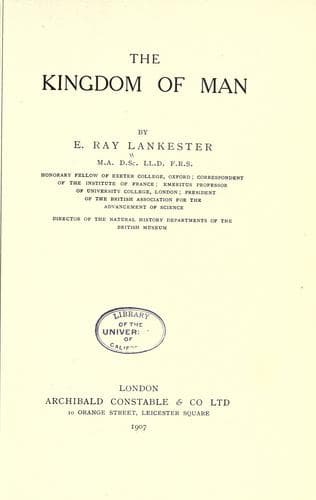
The Kingdom of ManLankester, E. Ray (Edwin Ray), Sir
History
The Kingdom of Man
Lankester, E. Ray (Edwin Ray), Sir
African trypanosomiasis; Human beings; Science -- History
Disease-germs, bacteria, or protozoa produce poisons which sometimes
are too much for the phagocytes, poisoning them and so getting
the upper hand. But, as Metschnikoff showed, the training of the
phagocytes by weak doses of the poison of the disease-germ, or by
weakened cultures of the disease-germ itself, brings about a power
of resistance in the phagocytes to the germ’s poison, and thus makes
them capable of attacking the germs and keeping them at bay. Hence
the value of inoculations.
The discussion and experiments arising from Metschnikoff’s
demonstrations have led to the discovery of the production by the
phagocytes of certain exudations from their substance which have a
most important effect in weakening the resistance of the intrusive
bacteria and rendering them easy prey for the phagocyte. These
are called ‘sensitisers,’ and have been largely studied. They may
be introduced artificially into the blood and tissues so as to
facilitate the work of the phagocytes, and no doubt it is a valuable
remedial measure to make use of such sensitisers as a treatment.
Dr. Wright considers that such sensitisers are formed in the blood
and tissues independently of the phagocytes, and has called them
‘opsonins,’ under which name he has made most valuable application
of the method of injecting them into the body so as to facilitate
the work of the phagocytes in devouring the hostile bacteria of
various diseases. Each kind of disease-producing microbe has its own
sensitiser or opsonin; hence there has been much careful research and
experiment required in order to bring the discovery into practical
use. Metschnikoff himself holds and quotes experiments to show that
the ‘opsonins’ are actually produced by the phagocytes themselves.
That this should be so is in accordance with some striking zoological
facts, as I pointed out nearly twenty years ago.[20] For the lowest
multicellular animals provided with a digestive sac or gut, such
as the polyps, have that sac lined by digestive cells which have
the same amœboid character as ‘phagocytes,’ and actually digest
to a large extent by swallowing or taking into their individual
protoplasm raw particles of food. Such particles are enclosed in a
temporary cavity, or vacuole, into which the cell-protoplasm secretes
digestive ferment and other chemical agents. Now there is no doubt
that such digestive vacuoles may burst and so pour out into the
polyp’s stomach a digestive juice which will act on food particles
outside the substance of the cells, and thus by the substitution of
this process of outpouring of the secretion for that of ingestion of
food particles into the cells we get the usual form of digestion by
juices secreted into a digestive cavity. Now this being certainly the
case in regard to the history of the original phagocytes lining the
polyp’s gut, it does not seem at all unlikely, but on the contrary in
a high degree probable, that the phagocytes of the blood and tissues
Public-domain text, read in full here on John Shaqi.
Reviews
Reviews
No reviews yet
Be the first to share your thoughts on this work.
Elsewhere in the archive
Join the Discussion
Join the discussion
Sign in to leave a comment or review.
Sign InorCreate an account