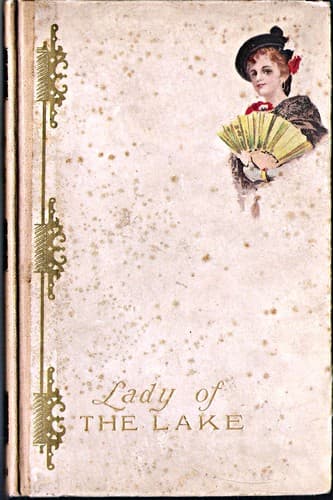
Arthurian romances; Lady of the Lake (Legendary character) -- Romances
'The lords hearing the king's complaint and lamentation, and also the
great rage, fury, and malice, that he bure toward the Earl of Angus, his
kin and friends, they concluded all and thought it best, that he should
be summoned to underly the law; if he fand not caution, nor yet compear
himself, that he should be put to the horn, with all his kin and
friends, so many as were contained in the letters. And further, the
lords ordained, by advice of his majesty, that his brother and friends
should be summoned to find caution to underly the law within a certain
day, or else be put to the horn. But the earl appeared not, nor none
for him; and so he was put to the horn, with all his kin and friends:
so many as were contained in the summons, that compeared not, were
banished, and holden traitors to the king.'"
159. From Tweed to Spey. From the Tweed, the southern boundary of
Scotland, to the Spey, a river far to the north in Invernessshire; that
is, from one end of the land to the other.
170. Reave. Tear away. The participle reft is still used, at least in
poetry. Cf. Shakespeare, V. and A. 766: "Or butcher-sire that reaves his
son of life" (that is, bereaves); Spenser, F. Q. i. 3. 36: "He to him
lept, in minde to reave his life;" Id. ii. 8. 15: "I will him reave of
arms," etc.
178. It drinks, etc. The MS. has "No blither dewdrop cheers the rose."
195, 196. To see... dance. This couplet is not in the MS.
200. The Lady of the Bleeding Heart. The bleeding heart was the
cognizance of the Douglas family. Robert Bruce, on his death-bed,
bequeathed his heart to his friend, the good Lord James, to be borne in
war against the Saracens. "He joined Alphonso, King of Leon and Castile,
then at war with the Moorish chief Osurga, of Granada, and in a keen
contest with the Moslems he flung before him the casket containing the
precious relic, crying out, 'Onward as thou wert wont, thou noble
heart, Douglas will follow thee.' Douglas was slain, but his body was
recovered, and also the precious casket, and in the end Douglas was laid
with his ancestors, and the heart of Bruce deposited in the church of
Melrose Abbey" (Burton's Hist. of Scotland).
201. Fair. The 1st ed. (and probably the MS., though not noted by
Lockhart) has "Gay."
203. Yet is this, etc. The MS. and 1st ed. read:
"This mossy rock, my friend, to me
Is worth gay chair and canopy."
205. Footstep. The reading of the 1st and other early eds.; "footsteps"
in recent ones.
206. Strathspey. A Highland dance, which takes its name from the strath,
or broad valley, of the Spey (159 above).
213. Clan-Alpine's pride. "The Siol Alpine, or race of Alpine, includes
several clans who claimed descent from Kenneth McAlpine, an ancient
king. These are the Macgregors, the Grants, the Mackies, the Mackinnans,
the MacNabs, the MacQuarries, and the Macaulays. Their common emblem was
the pine, which is now confined to the Macgregors" (Taylor).
Public-domain text, read in full here on John Shaqi.
Reviews
Reviews
No reviews yet
Be the first to share your thoughts on this work.
Elsewhere in the archive
Join the Discussion
Join the discussion
Sign in to leave a comment or review.
Sign InorCreate an account