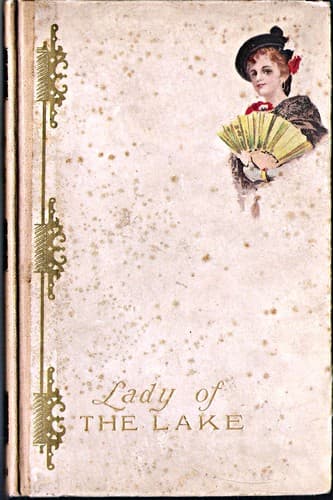
Arthurian romances; Lady of the Lake (Legendary character) -- Romances
251. Orphan. Referring to child, not to she, as its position indicates.
254. Shrouds. Shields, protects. Cf. Spenser, F. Q. i. 1. 6: "And this
faire couple eke to shroud themselves were fain" (that is, from the
rain). So the noun = shelter, protection; as in Shakespeare, A. and
C. iii. 13. 71: "put yourself under his shroud," etc. See also on 757
below.
260. Maronnan's cell. "The parish of Kilmaronock, at the eastern
extremity of Loch Lomond, derives its name from a cell, or chapel,
dedicated to Saint Maronock, or Marnock, or Maronnan, about whose
sanctity very little is now remembered" (Scott). Kill = cell; as
in Colmekill (Macb. ii. 4. 33), "the cell of Columba," now known as
Icolmkill, or Iona.
270. Bracklinn's thundering wave. This beautiful cascade is on the
Keltie, a mile from Callander. The height of the fall is about fifty
feet. "A few years ago a marriage party of Lowland peasants met with
a tragic end here, two of them having tumbled into the broken, angry
waters, where they had no more chance of life than if they had dropped
into the crater of Hecla" (Black).
271. Save. Unless; here followed by the subjunctive.
274. Claymore. The word means "a large sword" (Gaelic claidheamh, sword,
and more, great).
294. Shadowy plaid and sable plume. Appropriate to Roderick Dhu. See on
220 above.
303. Woe the while. Woe be to the time, alas the time! Cf. Shakespeare,
J. C. i. 3. 82: "But, woe the while! our fathers' minds are dead," etc.
See also on i. 166 above.
306. Tine-man. "Archibald, the third Earl of Douglas, was so unfortunate
in all his enterprises, that he acquired the epithet of 'tine-man,'
because he tined, or lost, his followers in every battle which he
fought. He was vanquished, as every reader must remember, in the bloody
battle of Homildon-hill, near Wooler, where he himself lost an eye, and
was made prisoner by Hotspur. He was no less unfortunate when allied
with Percy, being wounded and taken at the battle of Shrewsbury. He was
so unsuccessful in an attempt to beseige Roxburgh Castle, that it was
called the 'Foul Raid,' or disgraceful expedition. His ill fortune left
him indeed at the battle of Beauge, in France; but it was only to return
with double emphasis at the subsequent action of Vernoil, the last and
most unlucky of his encounters, in which he fell, with the flower of the
Scottish chivalry, then serving as auxiliaries in France, and about two
thousand common soldiers, A.D. 1424" (Scott).
307. What time, etc. That is, at the time when Douglas allied
himself with Percy in the rebellion against Henry IV. of England. See
Shakespeare, 1 Hen. IV.
Public-domain text, read in full here on John Shaqi.
Reviews
Reviews
No reviews yet
Be the first to share your thoughts on this work.
Elsewhere in the archive
Join the Discussion
Join the discussion
Sign in to leave a comment or review.
Sign InorCreate an account