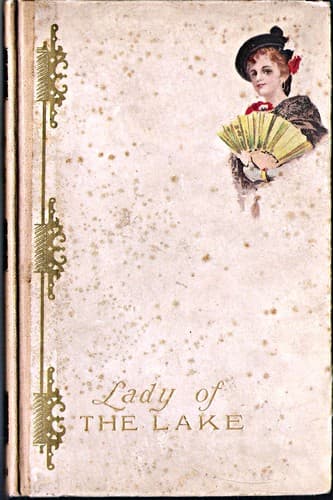
Arthurian romances; Lady of the Lake (Legendary character) -- Romances
342. Spears, pikes, and axes. The 1st ed. and that of 1821 have Spears,
but all the recent ones misprint "Spear." The "Globe" ed. has "Spear,
spikes," etc.
343. Tartans. The checkered woollen cloth so much worn in Scotland.
Curiously enough, the name is not Gaelic but French. See Jamieson or Wb.
Brave. Fine, beautiful; the same word as the Scottish braw. Cf.
Shakespeare, Sonn. 12. 2: "And see the brave day sunk in hideous night;"
Ham. ii. 2. 312: "This brave o'erhanging firmament," etc. It is often
used of dress, as also is bravery (= finery); as in T. of S. iv. 3. 57:
"With scarfs and fans and double change of bravery." See also Spenser,
Mother Hubberds Tale, 858: "Which oft maintain'd his masters braverie"
(that is, dressed as well as his master).
351. Chanters. The pipes of the bagpipes, to which long ribbons were
attached.
357. The sounds. Misprinted "the sound" in the ed. of 1821, and all the
more recent eds. that we have seen. Cf. 363 below.
363. Those thrilling sounds, etc. Scott says here: "The connoisseurs in
pipe-music affect to discover in a well-composed pibroch, the imitative
sounds of march, conflict, flight, pursuit, and all the 'current of a
heady fight.' To this opinion Dr. Beattie has given his suffrage,
in that following elegant passage:--'A pibroch is a species of tune,
peculiar, I think, to the Highlands and Western Isles of Scotland. It
is performed on a bagpipe, and differs totally from all other music. Its
rhythm is so irregular, and its notes, especially in the quick movement,
so mixed and huddled together, that a stranger finds it impossible to
reconcile his ear to it, so as to perceive its modulation. Some of
these pibrochs, being intended to represent a battle, begin with a grave
motion, resembling a march; then gradually quicken into the onset;
run off with noisy confusion, and turbulent rapidity, to imitate the
conflict and pursuit; then swell into a few flourishes of triumphant
joy; and perhaps close with the wild and slow wailings of a funeral
procession' (Essay on Laughter and Ludicrious Composition, chap. iii.
note)."
367. Hurrying. Referring to their, or rather to the them implied in that
word.
392. The burden bore. That is, sustained the burden, or chorus, of the
song. Cf. Shakespeare, Temp. i. 2. 381: "And, sweet sprites, the burden
bear."
399. Hail to the Chief, etc. The metre of the song is dactylic; the
accents being on the 1st, 4th, 7th, and 10th syllables. It is little
used in English. Tennyson's Charge of the Light Brigade and Longfellow's
Skeleton in Armor are familiar examples of it.
405. Bourgeon. Bud. Cf. Fairfax, Tasso, vii. 76: When first on trees
bourgeon the blossoms soft;" and Tennyson, In Memoriam, 115:
"Now burgeons every maze of quick
About the flowering squares," etc.
Public-domain text, read in full here on John Shaqi.
Reviews
Reviews
No reviews yet
Be the first to share your thoughts on this work.
Elsewhere in the archive
Join the Discussion
Join the discussion
Sign in to leave a comment or review.
Sign InorCreate an account