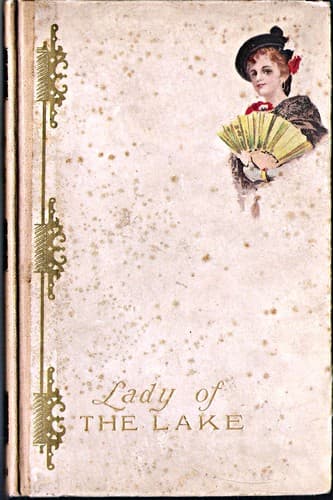
Arthurian romances; Lady of the Lake (Legendary character) -- Romances
above their heads, they turn themselves round and round, till they are
enveloped by the whole mantle. They then lay themselves down on the
heath, upon the leeward side of some hill, where the wet and the warmth
of their bodies make a steam, like that of a boiling kettle. The wet,
they say, keeps them warm by thickening the stuff, and keeping the wind
from penetrating. I must confess I should have been apt to question this
fact, had I not frequently seen them wet from morning to night, and,
even at the beginning of the rain, not so much as stir a few yards to
shelter, but continue in it without necessity, till they were, as we
say, wet through and through. And that is soon effected by the looseness
and spunginess of the plaiding; but the bonnet is frequently taken
off, and wrung like a dishclout, and then put on again. They have been
accustomed from their infancy to be often wet, and to take the water
like spaniels, and this is become a second nature, and can scarcely be
called a hardship to them, insomuch that I used to say, they seemed to
be of the duck kind, and to love water as well. Though I never saw this
preparation for sleep in windy weather, yet, setting out early in a
morning from one of the huts, I have seen the marks of their lodging,
where the ground has been free from rime or snow, which remained all
round the spot where they had lain' (Letters from Scotland, Lond. 1754,
8vo, ii. p. 108)."
809. His henchman. Scott quotes again the Letters from Scotland (ii.
159): "This officer is a sort of secretary, and is to be ready, upon
all occasions, to venture his life in defence of his master; and at
drinking-bouts he stands behind his seat, at his haunch, from whence
his title is derived, and watches the conversation, to see if any one
offends his patron. An English officer being in company with a certain
chieftain, and several other Highland gentlemen, near Killichumen, had
an argument with the great man; and both being well warmed with usky
[whisky], at last the dispute grew very hot. A youth who was henchman,
not understanding one word of English, imagined his chief was insulted,
and thereupon drew his pistol from his side, and snapped it at the
officer's head; but the pistol missed fire, otherwise it is more than
probable he might have suffered death from the hand of that little
vermin. But it is very disagreeable to an Englishman over a bottle with
the Highlanders, to see every one of them have his gilly, that is, his
servant, standing behind him all the while, let what will be the subject
of conversation."
829. On the morn. Modifying should circle, not the nearer verb had
sworn.
831. The Fiery Cross. See on iii. 18 below.
846. Point. Point out, appoint. Cf. Shakespeare, Sonn. 14. 6:
"Nor can I fortune to brief minutes tell,
Pointing to each his thunder, rain, and wind."
The word in this and similar passages is generally printed "'point" by
modern editors, but it is not a contraction of appoint.
Public-domain text, read in full here on John Shaqi.
Reviews
Reviews
No reviews yet
Be the first to share your thoughts on this work.
Elsewhere in the archive
Join the Discussion
Join the discussion
Sign in to leave a comment or review.
Sign InorCreate an account