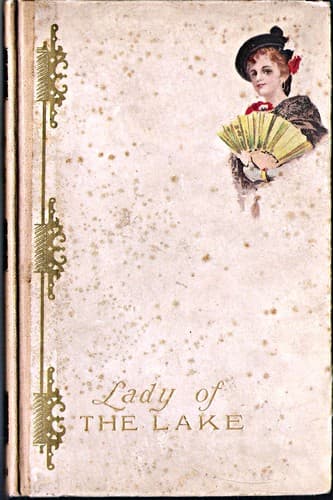
Arthurian romances; Lady of the Lake (Legendary character) -- Romances
Scott has the following note here: "Most great families in the Highlands
were supposed to have a tutelar, or rather a domestic, spirit, attached
to them, who took an interest in their prosperity, and intimated, by its
wailings, any approaching disaster. That of Grant of Grant was called
May Moullach, and appeared in the form of a girl, who had her arm
covered with hair. Grant of Rothiemurcus had an attendant called
Bodach-an-dun, or the Ghost of the Hill; and many other examples might
be mentioned. The Ben-Shie implies the female fairy whose lamentations
were often supposed to precede the death of a chieftain of particular
families. When she is visible, it is in the form of an old woman, with
a blue mantle and streaming hair. A superstition of the same kind is, I
believe, universally received by the inferior ranks of the native Irish.
"The death of the head of a Highland family is also sometimes supposed
to be announced by a chain of lights of different colours, called
Dr'eug, or death of the Druid. The direction which it takes marks the
place of the funeral." [See the Essay on Fairy Superstitions in Scott's
Border Minstrelsy.]
169. Sounds, too, had come, etc. Scott says: "A presage of the kind
alluded to in the text, is still believed to announce death to the
ancient Highland family of M'Lean of Lochbuy. The spirit of an ancestor
slain in battle is heard to gallop along a stony bank, and then to ride
thrice around the family residence, ringing his fairy bridle, and thus
intimating the approaching calamity. How easily the eye as well as the
ear may be deceived upon such occasions, is evident from the stories
of armies in the air, and other spectral phenomena with which history
abounds. Such an apparition is said to have been witnessed upon the side
of Southfell mountain, between Penrith and Keswick, upon the 23d June,
1744, by two persons, William Lancaster of Blakehills, and Daniel
Stricket his servant, whose attestation to the fact, with a full account
of the apparition, dated the 21st of July, 1745, is printed in Clarke's
Survey of the Lakes. The apparition consisted of several troops of horse
moving in regular order, with a steady rapid motion, making a curved
sweep around the fell, and seeming to the spectators to disappear over
the ridge of the mountain. Many persons witnessed this phenomenon, and
observed the last, or last but one, of the supposed troop, occasionally
leave his rank, and pass, at a gallop, to the front, when he resumed the
steady pace. The curious appearance, making the necessary allowance
for imagination, may be perhaps sufficiently accounted for by optical
deception."
171. Shingly. Gravelly, pebbly.
173. Thunderbolt. The 1st ed. has "thunder too."
188. Framed. The reading of the 1st ed.; commonly misprinted "formed,"
which occurs in 195.
190. Limbs. The 1st ed. has "limb."
Public-domain text, read in full here on John Shaqi.
Reviews
Reviews
No reviews yet
Be the first to share your thoughts on this work.
Elsewhere in the archive
Join the Discussion
Join the discussion
Sign in to leave a comment or review.
Sign InorCreate an account