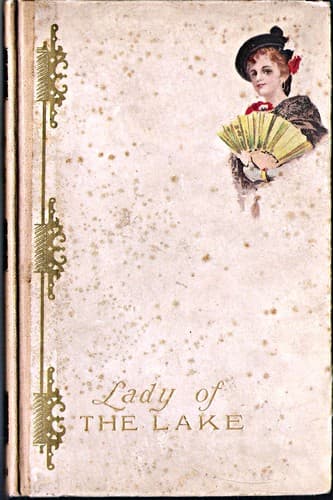
Arthurian romances; Lady of the Lake (Legendary character) -- Romances
''T is no base weed--no planted tree,
Nor a seedling of last Autumn;
Nor a sapling planted at Beltain; [7]
Wide, wide around were spread its lofty branches--
But the topmost bough is lowly laid!
Thou hast forsaken us before Sawaine. [8]
'Thy dwelling is the winter house;--
Loud, sad, and mighty is thy death-song!
Oh! courteous champion of Montrose!
Oh! stately warrior of the Celtic Isles!
Thou shalt buckle thy harness on no more!'
"The coronach has for some years past been suspended at funerals by
the use of the bagpipe; and that also is, like many other Highland
peculiarities, falling into disuse, unless in remote districts."
370. He is gone, etc. As Taylor remarks, the metre of this dirge seems
to be amphibrachic; that is, made up of feet, or metrical divisions,
of three syllables, the second of which is accented. Some of the lines
appear to be anapestic (made up of trisyllabic feet, with the last
syllable accented); but the rhythm of these is amphibrachic; that is,
the rhythmic pause is after the syllable that follows the accent.
"(He) is gone on | the mountain,
{Like) a summer- | dried fountain."
Ten lines out of twenty-four are distinctly amphibrachic, as
"To Duncan | no morrow."
So that it seems best to treat the rest as amphibrachic, with a
superfluous unaccented syllable at the beginning of the line. Taylor
adds: "The song is very carefully divided. To each of the three things,
mountain, forest, fountain, four lines are given, in the order 3, 1, 2."
384. In flushing. In full bloom. Cf. Hamlet, iii. 3. 81: "broad blown,
as flush as May."
386. Correi. A hallow in the side of a hill, where game usually lies.
387. Cumber. Trouble, perplexity. Cf. Fairfax, Tasso ii. 73: "Thus
fade thy helps, and thus thy cumbers spring;" and Sir John Harrington,
Epigrams, i. 94: "without all let [hindrance] or cumber."
388. Red. Bloody, not afraid of the hand-to-hand fight.
394. Stumah. "Faithful; the name of a dog" (Scott).
410. Angus, the heir, etc. The MS. reads:
"Angus, the first of Duncan's line,
Sprung forth and seized the fatal sign,
And then upon his kinsman's bier
Fell Malise's suspended tear.
In haste the stripling to his side
His father's targe and falchion tied."
439. Hest. Behest, bidding; used only in poetry. Cf. Shakespeare, Temp.
iii. 1. 37: "I have broke your hest to say so;" Id. iv. 1. 65: "at thy
hest," etc.
Public-domain text, read in full here on John Shaqi.
Reviews
Reviews
No reviews yet
Be the first to share your thoughts on this work.
Elsewhere in the archive
Join the Discussion
Join the discussion
Sign in to leave a comment or review.
Sign InorCreate an account