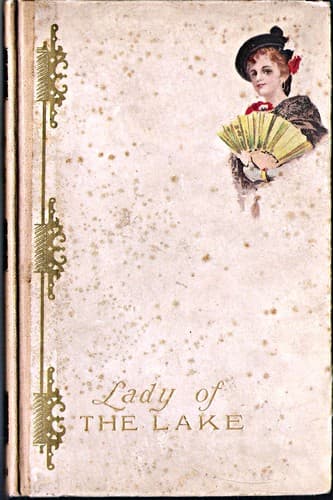
Arthurian romances; Lady of the Lake (Legendary character) -- Romances
383. Trained abroad. That is, in France. See on i. 163 above. Scott says
here: "The use of defensive armor, and particularly of the buckler,
or target, was general in Queen Elizabeth's time, although that of the
single rapier seems to have been occasionally practised much earlier
(see Douce's Illustrations of Shakespeare, vol. ii. p. 61). Rowland
Yorke, however, who betrayed the fort of Zutphen to the Spaniards, for
which good service he was afterwards poisoned by them, is said to have
been the first who brought the rapier-fight into general use. Fuller,
speaking of the swash-bucklers, or bullies, of Queen Elizabeth's time,
says, 'West Smithfield was formerly called Ruffian's Hall, where such
men usually met, casually or otherwise, to try masteries with sword
or buckler. More were frightened than hurt, more hurt than killed
therewith, it being accounted unmanly to strike beneath the knee. But
since that desperate traitor Rowland Yorke first introduced thrusting
with rapiers, sword and buckler are disused.' In The Two Angry Women
of Abingdon, a comedy, printed in 1599, we have a pathetic complaint:
'Sword and buckler fight begins to grow out of use. I am sorry for it;
I shall never see good manhood again. If it be once gone, this poking
fight of rapier and dagger will come up; then a tall man and a good
sword and buckler man will be spitted like a cat or rabbit.' But the
rapier had upon the Continent long superseded, in private duel, the use
of sword and shield. The masters of the noble science of defence were
chiefly Italians. They made great mystery of their art and mode of
instruction, never suffered any person to be present but the scholar who
was to be taught, and even examined closets, beds, and other places
of possible concealment. Their lessons often gave the most treacherous
advantages; for the challenged, having the right to choose his weapons,
frequently selected some strange, unusual, and inconvenient kind of
arms, the use of which he practised under these instructors, and thus
killed at his ease his antagonist, to whom it was presented for the
first time on the field of battle. See Brantome's Discourse on Duels,
and the work on the same subject, 'si gentement ecrit,' by the venerable
Dr. Paris de Puteo. The Highlanders continued to use broadsword and
target until disarmed after the affair of 1745-6."
385. Ward. Posture of defence; a technical term in fencing. Cf.
Falstaff's "Thou knowest my old ward" (1 Hen. IV. ii. 4. 215), etc.
387. While less expert, etc. The MS. reads:
"Not Roderick thus, though stronger far,
More tall, and more inured to war."
401, 402. And backward, etc. This couplet is not in the MS.; and the
same is true of 405, 406.
Public-domain text, read in full here on John Shaqi.
Reviews
Reviews
No reviews yet
Be the first to share your thoughts on this work.
Elsewhere in the archive
Join the Discussion
Join the discussion
Sign in to leave a comment or review.
Sign InorCreate an account