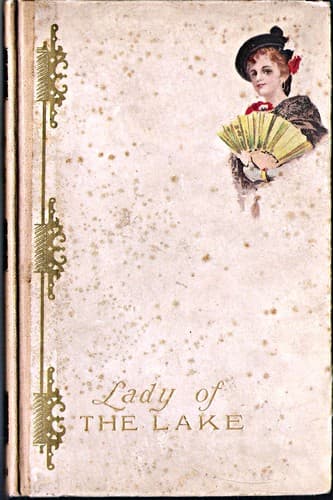
Arthurian romances; Lady of the Lake (Legendary character) -- Romances
47. Adventurers they, etc. Scott says: "The Scottish armies consisted
chiefly of the nobility and barons, with their vassals, who held lands
under them for military service by themselves and their tenants. The
patriarchal influence exercised by the heads of clans in the Highlands
and Borders was of a different nature, and sometimes at variance with
feudal principles. It flowed from the Patria Potestas, exercised by the
chieftain as representing the original father of the whole name, and
was often obeyed in contradiction to the feudal superior. James V. seems
first to have introduced, in addition to the militia furnished from
these sources, the service of a small number of mercenaries, who formed
a body-guard, called the Foot-Band. The satirical poet, Sir David
Lindsay (or the person who wrote the prologue to his play of the Three
Estaites), has introduced Finlay of the Foot-Band, who after much
swaggering upon the stage is at length put to flight by the Fool, who
terrifies him by means of a sheep's skull upon a pole. I have rather
chosen to give them the harsh features of the mercenary soldiers of the
period, than of this Scottish Thraso. These partook of the character of
the Adventurous Companions of Froissart, or the Condottieri of Italy."
53. The Fleming, etc. The soil of Flanders is very fertile and
productive, in marked contrast to the greater part of Scotland.
60. Halberd. A combination of spear and battle-axe. See Wb.
63. Holytide. Holiday. For tide = time, see on iii. 478 above.
73. Neighboring to. That is, lying in adjacent rooms.
75. Burden. Alluding to the burden, or chorus, of a song. Cf. ii. 392
above. The MS. has "jest" for joke; and in the next line "And rude oaths
vented by the rest."
78. Trent. the English river of that name. Cf. 231 below.
84. That day. Modifying cut shore, not grieved.
87. A merry catch, I troll. Cf. Shakespeare, Temp, iii. 2. 126: "will
you troll the catch," etc.
88. Buxom. Lively, brisk; as in Hen. V. iii. 6. 27: "of buxom valour,"
etc. Its original sense was yielding, obedient; as in F. Q. i. 11. 37:
"the buxome aire" (see also Milton, P. L. ii. 842); and Id. iii. 2. 23:
"Of them that to him buxome are and prone." For the derivation, see Wb.
90. Poule. Paul; an old spelling, found in Chaucer and other writers.
The measure of the song is anapestic (that is, with the accent on every
third syllable), with modifications.
92. Black-jack. A kind of pitcher made of leather. Taylor quotes Old
Mortality, chap. viii.: "The large black-jack filled with very small
beer."
93. Sack. A name applied to Spanish and Canary wines in general; but
sometimes the particular kind was specified. Cf. 2 Hen. IV. iv. 3. 104:
"good sherris-sack" (that is, sherry wine); and Herrick, Poems:
"thy isles shall lack
Grapes, before Herrick leaves Canarie sack."
Public-domain text, read in full here on John Shaqi.
Reviews
Reviews
No reviews yet
Be the first to share your thoughts on this work.
Elsewhere in the archive
Join the Discussion
Join the discussion
Sign in to leave a comment or review.
Sign InorCreate an account