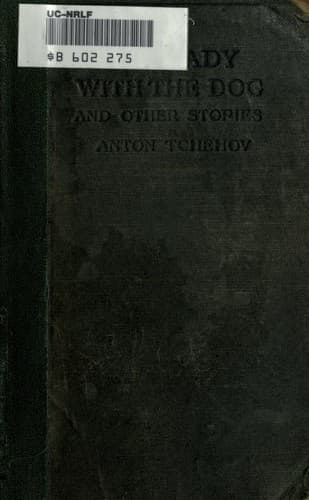
The Lady with the Dog and Other StoriesChekhov, Anton Pavlovich
General
The Lady with the Dog and Other Stories
Chekhov, Anton Pavlovich
Chekhov, Anton Pavlovich, 1860-1904 -- Translations into English; Russia -- Social life and customs -- Fiction
He drank some more. Pale and lean, with his dinner-napkin over his chest
like a little pinafore, he ate greedily, and raising his eyebrows, kept
looking guiltily, like a little boy, first at Zinaida Fyodorovna and
then at me. It seemed as though he would have begun crying if I had not
given him the grouse or the jelly. When he had satisfied his hunger he
grew more lively, and began laughingly telling some story about the
Birshov household, but perceiving that it was tiresome and that Zinaida
Fyodorovna was not laughing, he ceased. And there was a sudden feeling
of dreariness. After he had finished his dinner they sat in the
drawing-room by the light of a single lamp, and did not speak; it was
painful to him to lie to her, and she wanted to ask him something, but
could not make up her mind to. So passed half an hour. Gruzin glanced at
his watch.
"I suppose it's time for me to go."
"No, stay a little.... We must have a talk."
Again they were silent. He sat down to the piano, struck one chord, then
began playing, and sang softly, "What does the coming day bring me?" but
as usual he got up suddenly and tossed his head.
"Play something," Zinaida Fyodorovna asked him.
"What shall I play?" he asked, shrugging his shoulders. "I have
forgotten everything. I've given it up long ago."
Looking at the ceiling as though trying to remember, he played two
pieces of Tchaikovsky with exquisite expression, with such warmth, such
insight! His face was just as usual--neither stupid nor intelligent--and
it seemed to me a perfect marvel that a man whom I was accustomed to see
in the midst of the most degrading, impure surroundings, was capable of
such purity, of rising to a feeling so lofty, so far beyond my reach.
Zinaida Fyodorovna's face glowed, and she walked about the drawing-room
in emotion.
"Wait a bit, Godmother; if I can remember it, I will play you
something," he said; "I heard it played on the violoncello."
Beginning timidly and picking out the notes, and then gathering
confidence, he played Saint-Saëns's "Swan Song." He played it through,
and then played it a second time.
"It's nice, isn't it?" he said.
Moved by the music, Zinaida Fyodorovna stood beside him and asked:
"Tell me honestly, as a friend, what do you think about me?"
"What am I to say?" he said, raising his eyebrows. "I love you and think
nothing but good of you. But if you wish that I should speak generally
about the question that interests you," he went on, rubbing his sleeve
near the elbow and frowning, "then, my dear, you know.... To follow
freely the promptings of the heart does not always give good people
happiness. To feel free and at the same time to be happy, it seems to
me, one must not conceal from oneself that life is coarse, cruel, and
merciless in its conservatism, and one must retaliate with what it
deserves--that is, be as coarse and as merciless in one's striving for
freedom. That's what I think."
Public-domain text, read in full here on John Shaqi.
Reviews
Reviews
No reviews yet
Be the first to share your thoughts on this work.
Elsewhere in the archive
Join the Discussion
Join the discussion
Sign in to leave a comment or review.
Sign InorCreate an account