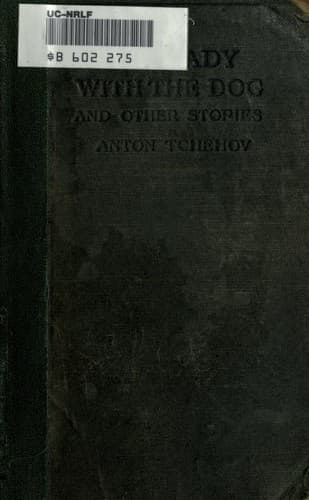
The Lady with the Dog and Other StoriesChekhov, Anton Pavlovich
General
The Lady with the Dog and Other Stories
Chekhov, Anton Pavlovich
Chekhov, Anton Pavlovich, 1860-1904 -- Translations into English; Russia -- Social life and customs -- Fiction
"We will go abroad together to-morrow," I said.
"That's impossible. My husband won't give me a passport."
"I will take you without a passport."
The cabman stopped at a wooden house of two storeys, painted a dark
colour. I rang. Taking from me her small light basket--the only luggage
we had brought with us--Zinaida Fyodorovna gave a wry smile and said:
"These are my _bijoux_."
But she was so weak that she could not carry these _bijoux_.
It was a long while before the door was opened. After the third or
fourth ring a light gleamed in the windows, and there was a sound of
steps, coughing and whispering; at last the key grated in the lock, and
a stout peasant woman with a frightened red face appeared at the door.
Some distance behind her stood a thin little old woman with short grey
hair, carrying a candle in her hand. Zinaida Fyodorovna ran into the
passage and flung her arms round the old woman's neck.
"Nina, I've been deceived," she sobbed loudly. "I've been coarsely,
foully deceived! Nina, Nina!"
I handed the basket to the peasant woman. The door was closed, but still
I heard her sobs and the cry "Nina!"
I got into the cab and told the man to drive slowly to the Nevsky
Prospect. I had to think of a night's lodging for myself.
Next day towards evening I went to see Zinaida Fyodorovna. She was
terribly changed. There were no traces of tears on her pale, terribly
sunken face, and her expression was different. I don't know whether it
was that I saw her now in different surroundings, far from luxurious,
and that our relations were by now different, or perhaps that intense
grief had already set its mark upon her; she did not strike me as so
elegant and well dressed as before. Her figure seemed smaller; there was
an abruptness and excessive nervousness about her as though she were in
a hurry, and there was not the same softness even in her smile. I was
dressed in an expensive suit which I had bought during the day. She
looked first of all at that suit and at the hat in my hand, then turned
an impatient, searching glance upon my face as though studying it.
"Your transformation still seems to me a sort of miracle," she said.
"Forgive me for looking at you with such curiosity. You are an
extraordinary man, you know."
I told her again who I was, and why I was living at Orlov's, and I told
her at greater length and in more detail than the day before. She
listened with great attention, and said without letting me finish:
"Everything there is over for me. You know, I could not refrain from
writing a letter. Here is the answer."
On the sheet which she gave there was written in Orlov's hand:
"I am not going to justify myself. But you must own that it was your
mistake, not mine. I wish you happiness, and beg you to make haste and
forget.
"Yours sincerely,
"G. O.
"P. S.--I am sending on your things."
The trunks and baskets despatched by Orlov were standing in the passage,
and my poor little portmanteau was there beside them.
Public-domain text, read in full here on John Shaqi.
Reviews
Reviews
No reviews yet
Be the first to share your thoughts on this work.
Elsewhere in the archive
Join the Discussion
Join the discussion
Sign in to leave a comment or review.
Sign InorCreate an account