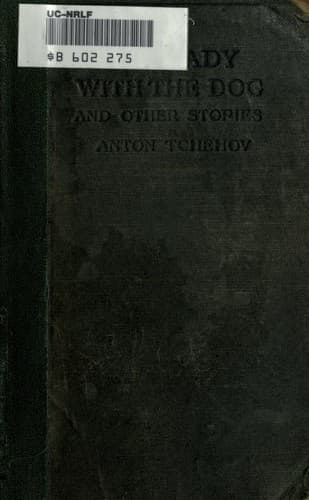
The Lady with the Dog and Other StoriesChekhov, Anton Pavlovich
General
The Lady with the Dog and Other Stories
Chekhov, Anton Pavlovich
Chekhov, Anton Pavlovich, 1860-1904 -- Translations into English; Russia -- Social life and customs -- Fiction
"You mean to say you despise my past, and you are right," she said,
deeply stirred. "You belong to a special class of men who cannot be
judged by ordinary standards; your moral requirements are exceptionally
rigorous, and I understand you can't forgive things. I understand you,
and if sometimes I say the opposite, it doesn't mean that I look at
things differently from you; I speak the same old nonsense simply
because I haven't had time yet to wear out my old clothes and
prejudices. I, too, hate and despise my past, and Orlov and my love....
What was that love? It's positively absurd now," she said, going to the
window and looking down at the canal. "All this love only clouds the
conscience and confuses the mind. The meaning of life is to be found
only in one thing--fighting. To get one's heel on the vile head of the
serpent and to crush it! That's the meaning of life. In that alone or in
nothing."
I told her long stories of my past, and described my really astounding
adventures. But of the change that had taken place in me I did not say
one word. She always listened to me with great attention, and at
interesting places she rubbed her hands as though vexed that it had not
yet been her lot to experience such adventures, such joys and terrors.
Then she would suddenly fall to musing and retreat into herself, and I
could see from her face that she was not attending to me.
I closed the windows that looked out on the canal and asked whether we
should not have the fire lighted.
"No, never mind. I am not cold," she said, smiling listlessly. "I only
feel weak. Do you know, I fancy I have grown much wiser lately. I have
extraordinary, original ideas now. When I think of my past, of my life
then ... people in general, in fact, it is all summed up for me in the
image of my stepmother. Coarse, insolent, soulless, false, depraved, and
a morphia maniac too. My father, who was feeble and weak-willed, married
my mother for her money and drove her into consumption; but his second
wife, my stepmother, he loved passionately, insanely.... What I had to
put up with! But what is the use of talking! And so, as I say, it is all
summed up in her image.... And it vexes me that my stepmother is dead. I
should like to meet her now!"
"Why?"
"I don't know," she answered with a laugh and a graceful movement of her
head. "Good-night. You must get well. As soon as you are well, we'll
take up our work ... It's time to begin."
After I had said good-night and had my hand on the door-handle, she
said:
"What do you think? Is Polya still living there?"
"Probably."
And I went off to my room. So we spent a whole month. One grey morning
when we both stood at my window, looking at the clouds which were moving
up from the sea, and at the darkening canal, expecting every minute that
it would pour with rain, and when a thick, narrow streak of rain covered
the sea as though with a muslin veil, we both felt suddenly dreary. The
same day we both set off for Florence.
XVI
Public-domain text, read in full here on John Shaqi.
Reviews
Reviews
No reviews yet
Be the first to share your thoughts on this work.
Elsewhere in the archive
Join the Discussion
Join the discussion
Sign in to leave a comment or review.
Sign InorCreate an account