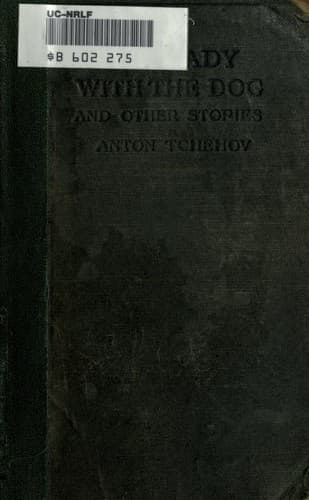
The Lady with the Dog and Other StoriesChekhov, Anton Pavlovich
General
The Lady with the Dog and Other Stories
Chekhov, Anton Pavlovich
Chekhov, Anton Pavlovich, 1860-1904 -- Translations into English; Russia -- Social life and customs -- Fiction
She used as before to come into my room in the morning to coffee, but we
no longer dined together, as she said she was not hungry; and she lived
only on coffee, tea, and various trifles such as oranges and caramels.
And we no longer had conversations in the evening. I don't know why it
was like this. Ever since the day when I had found her in tears she had
treated me somehow lightly, at times casually, even ironically, and for
some reason called me "My good sir." What had before seemed to her
terrible, heroic, marvellous, and had stirred her envy and enthusiasm,
did not touch her now at all, and usually after listening to me, she
stretched and said:
"Yes, 'great things were done in days of yore,' my good sir."
It sometimes happened even that I did not see her for days together. I
would knock timidly and guiltily at her door and get no answer; I would
knock again--still silence.... I would stand near the door and listen;
then the chambermaid would pass and say coldly, "_Madame est partie._"
Then I would walk about the passages of the hotel, walk and walk....
English people, full-bosomed ladies, waiters in swallow-tails.... And as
I keep gazing at the long striped rug that stretches the whole length of
the corridor, the idea occurs to me that I am playing in the life of
this woman a strange, probably false part, and that it is beyond my
power to alter that part. I run to my room and fall on my bed, and think
and think, and can come to no conclusion; and all that is clear to me is
that I want to live, and that the plainer and the colder and the harder
her face grows, the nearer she is to me, and the more intensely and
painfully I feel our kinship. Never mind "My good sir," never mind her
light careless tone, never mind anything you like, only don't leave me,
my treasure. I am afraid to be alone.
Then I go out into the corridor again, listen in a tremor.... I have no
dinner; I don't notice the approach of evening. At last about eleven I
hear the familiar footstep, and at the turn near the stairs Zinaida
Fyodorovna comes into sight.
"Are you taking a walk?" she would ask as she passes me. "You had better
go out into the air.... Good-night!"
"But shall we not meet again to-day?"
"I think it's late. But as you like."
"Tell me, where have you been?" I would ask, following her into the
room.
"Where? To Monte Carlo." She took ten gold coins out of her pocket and
said: "Look, my good sir; I have won. That's at roulette."
"Nonsense! As though you would gamble."
"Why not? I am going again to-morrow."
I imagined her with a sick and morbid face, in her condition, tightly
laced, standing near the gaming-table in a crowd of cocottes, of old
women in their dotage who swarm round the gold like flies round the
honey. I remembered she had gone off to Monte Carlo for some reason in
secret from me.
"I don't believe you," I said one day. "You wouldn't go there."
"Don't agitate yourself. I can't lose much."
Public-domain text, read in full here on John Shaqi.
Reviews
Reviews
No reviews yet
Be the first to share your thoughts on this work.
Elsewhere in the archive
Join the Discussion
Join the discussion
Sign in to leave a comment or review.
Sign InorCreate an account