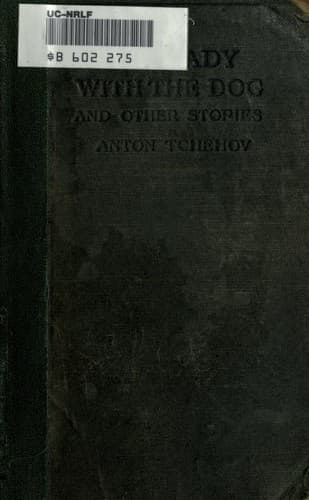
The Lady with the Dog and Other StoriesChekhov, Anton Pavlovich
General
The Lady with the Dog and Other Stories
Chekhov, Anton Pavlovich
Chekhov, Anton Pavlovich, 1860-1904 -- Translations into English; Russia -- Social life and customs -- Fiction
I went in to see Zinaida Fyodorovna, feeling as though I were the father
of the child. She was lying with her eyes closed, looking thin and pale,
wearing a white cap edged with lace. I remember there were two
expressions on her face: one--cold, indifferent, apathetic; the other--a
look of childish helplessness given her by the white cap. She did not
hear me come in, or heard, perhaps, but did not pay attention. I stood,
looked at her, and waited.
But her face was contorted with pain; she opened her eyes and gazed at
the ceiling, as though wondering what was happening to her.... There was
a look of loathing on her face.
"It's horrible ..." she whispered.
"Zinaida Fyodorovna." I spoke her name softly. She looked at me
indifferently, listlessly, and closed her eyes. I stood there a little
while, then went away.
At night, Darya Mihailovna informed me that the child, a girl, was born,
but that the mother was in a dangerous condition. Then I heard noise and
bustle in the passage. Darya Mihailovna came to me again and with a face
of despair, wringing her hands, said:
"Oh, this is awful! The doctor suspects that she has taken poison! Oh,
how badly Russians do behave here!"
And at twelve o'clock the next day Zinaida Fyodorovna died.
XVIII
Two years had passed. Circumstances had changed; I had come to
Petersburg again and could live here openly. I was no longer afraid of
being and seeming sentimental, and gave myself up entirely to the
fatherly, or rather idolatrous feeling roused in me by Sonya, Zinaida
Fyodorovna's child. I fed her with my own hands, gave her her bath, put
her to bed, never took my eyes off her for nights together, and screamed
when it seemed to me that the nurse was just going to drop her. My
thirst for normal ordinary life became stronger and more acute as time
went on, but wider visions stopped short at Sonya, as though I had found
in her at last just what I needed. I loved the child madly. In her I saw
the continuation of my life, and it was not exactly that I fancied, but
I felt, I almost believed, that when I had cast off at last my long,
bony, bearded frame, I should go on living in those little blue eyes,
that silky flaxen hair, those dimpled pink hands which stroked my face
so lovingly and were clasped round my neck.
Sonya's future made me anxious. Orlov was her father; in her birth
certificate she was called Krasnovsky, and the only person who knew of
her existence, and took interest in her--that is, I--was at death's
door. I had to think about her seriously.
The day after I arrived in Petersburg I went to see Orlov. The door was
opened to me by a stout old fellow with red whiskers and no moustache,
who looked like a German. Polya, who was tidying the drawing-room, did
not recognise me, but Orlov knew me at once.
"Ah, Mr. Revolutionist!" he said, looking at me with curiosity, and
laughing. "What fate has brought you?"
Public-domain text, read in full here on John Shaqi.
Reviews
Reviews
No reviews yet
Be the first to share your thoughts on this work.
Elsewhere in the archive
Join the Discussion
Join the discussion
Sign in to leave a comment or review.
Sign InorCreate an account