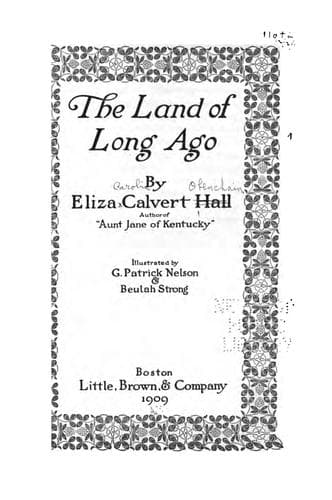
Kentucky -- Fiction; Older women -- Fiction; Widows -- Fiction
Aunt Jane removed her glasses and folded her withered hands over the
sacred pages. "You know, child," she said, "the Bible's the word of
God. I ain't questionin' that. But it looks like to me there's some o'
the words of man in it, too. Now this psalm I've jest read is the very
one to read at a watch-meetin' on New-year's eve because it's all
about time and life and the passin' o' the years, but there's some o'
the verses I'd like to leave out. There's that tenth one about 'the
days of our years' and the strength of our years. I reckon we all feel
like sayin' such things when we git tired and it looks like we haven't
done the work we set out to do, but that's the sort o' feelin' to keep
to ourselves. It don't do any good to tell such feelin's. And when a
man can say that the Lord has been his dwellin' place in all
generations, he oughtn't to turn right around and say that the
strength of his years is jest labor and sorrow. The trouble with some
folks is that they're always lookin' back and countin' the years
wherein they have seen evil, but they don't ricollect that the Lord's
promise is to make us glad accordin' to the evil years. Trouble has
got to come to us, child, but whenever it comes we ought to know
there's happiness comin' to make up for it jest like this psalm says,
'Make us glad according to the days wherein thou hast afflicted us,
and the years wherein we have seen evil.' I've lived pretty near
eighty years, and I've had my share o' trouble, but I'm far from
sayin' that the strength of my years is nothin' but labor and sorrow.
I never had a sorrow that I didn't know there was a happiness comin'
to make up for it. I've spent my life 'as a tale that is told,' and
I'm nearly to the end of it, but I'd be right glad, child, if I could
go back to the beginnin' and have it told all over again."
It is easy to pronounce a benediction on life when life is in its
morning; but with the darkness of the long night closing around us the
words that rise most often to human lips are the words of the cynic
king who, from "the dazzling height of a throne," surveyed the
magnificent ruin of his years and said,
"Vanity of vanities; all is vanity."
God once looked at a seething chaos which he called his world and
pronounced it good. Only a divinity could do this. And only the
divinity in man enables one to look back on the chaos of sorrow,
ecstasy, hope, despair, labor, failure, sin, and suffering which we
call life and say, "It is all good; I would live it again if I might."
Public-domain text, read in full here on John Shaqi.
Reviews
Reviews
No reviews yet
Be the first to share your thoughts on this work.
Elsewhere in the archive
Join the Discussion
Join the discussion
Sign in to leave a comment or review.
Sign InorCreate an account