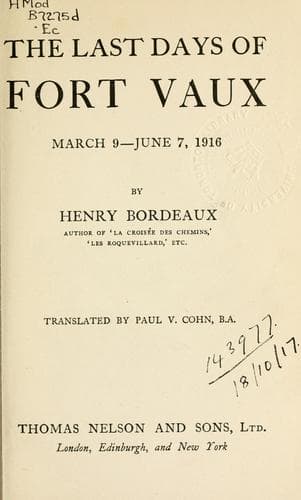
The Last Days of Fort Vaux, March 9-June 7, 1916Bordeaux, Henry
History
The Last Days of Fort Vaux, March 9-June 7, 1916
Bordeaux, Henry
Verdun, Battle of, Verdun, France, 1916; World War, 1914-1918 -- Personal narratives
“GENERAL HEADQUARTERS OF THE ATTACKING TROOPS
NORTH-EAST OF VAUX, _June 4_.
“On June 2, at four o’clock in the morning, the four attacking
companies were drawn up in a semicircle round Fort Vaux, at about
100 yards’ distance; at one swoop they pushed forward even to
the ditch, which, 10 yards broad and 5 deep, encloses the whole
earthwork, in the form of an irregular trapezoid, within its sheer
walls built of large square stones. Across the appalling curtain
fire of the French we had only been able to convey a part of
our war material up to the heights of the fort: flame-throwers,
hand-grenades, axes, and wire-cutters.
“In consequence of the long bombardment with heavy guns, the fort,
though very massively built, was no longer capable of defending
the surrounding space effectively; but the dug-outs, hollowed
out deep in the rocks and covered with reinforced concrete, had
held out. The flanking transverse passages of the fort, too, were
still factors to be reckoned with. Accordingly the first problem
was to make their artillery and machine-guns harmless; for these,
with their raking fire, churned up the bottom of the ditch, and
prevented us from crossing and reaching the interior of the fort.
Each of the two breastworks in front showed an open breach, caused
by very heavy projectiles, in the gigantic blocks of concrete of
which they were formed. The damage was repaired, up to a point,
by sandbags; and, to protect the breach, they had placed there a
machine-gun which might be able to operate towards the glacis. The
principal obstacle, however, was still the guns of the transverse
passages, which from their narrow concrete embrasures could sweep
the short line of the ditches with a pitiless fire. Access to
either of the breastworks was impeded by the fire of a 37 mm.
revolving gun, a 55 mm. gun, and by two machine-guns. Not a cat
could have passed through.
“First of all, the machine-gun, which at the very breach prevented
our approach, was silenced by hand-grenades. Then the pioneers
crept right up to the upper edge of the escarped wall, above
the western transverse passage, set up the flame-throwers, and,
from above, with the aid of a crank shaft, inserted the tubes of
the flame-throwers into the embrasures. A flame of two yards,
accompanied by dense smoke, drove the garrison far away from its
guns.
Public-domain text, read in full here on John Shaqi.
Reviews
Reviews
No reviews yet
Be the first to share your thoughts on this work.
Elsewhere in the archive
Join the Discussion
Join the discussion
Sign in to leave a comment or review.
Sign InorCreate an account