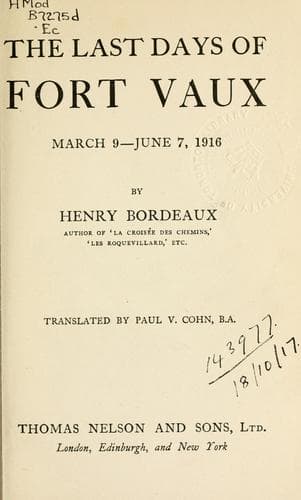
The Last Days of Fort Vaux, March 9-June 7, 1916Bordeaux, Henry
History
The Last Days of Fort Vaux, March 9-June 7, 1916
Bordeaux, Henry
Verdun, Battle of, Verdun, France, 1916; World War, 1914-1918 -- Personal narratives
“On June 5 and 6, the position of the French garrison grew steadily
worse; the number of dead and especially of wounded increased with
rapid strides; at last there were no more than a hundred pints of
water left, even for the wounded. Those who had not been wounded
had not a drop, and had eaten scarcely anything since the 4th.
Yet the French continued to fire from the direction of the gorge,
through the embrasures in the barracks and those in the ditch, at
every target that offered itself. In this way the German garrison
of Fort Vaux suffered losses. Other losses, by no means negligible,
were inflicted upon it by the continual flanking fire directed
against the fort from the infantry tactical point, situated quite
close at hand, to the west; it was provided with a field gun.
Similarly, the high-perched battery of Damloup, on the south,
opened a very troublesome bombardment.
“On the afternoon of June 6 the position of the Germans became
extremely hazardous. The casemates which they occupied were
assiduously peppered, at first with gas projectiles, somewhat later
by heavy shells. The two bombardments were clearly the forerunners
of an infantry counter-attack aiming at the recapture of the
earthwork from the south-west. This attack, however, was brought
to nought by the overpowering effects of the German curtain fire,
which opened as soon as the attack was started.
“To-day, at dawn, the French garrison surrendered through the
medium of its commandant. The prisoners who are beginning to come
in are the living image of misery.
“KURT VON REDEN.”
The text, which has been suitably edited, calls for some brief comments.
The engagement before the fort on June 2 is pictured as quite separate
from the fighting of the previous day round the Hardaumont salient,
Fumin Wood, and the line of entrenchments, and, on the same day, at
Damloup and by the Damloup battery. As a matter of fact, it forms an
integral part of all this fighting. It was the retreat of the details,
placed west and east of the fort and overwhelmed by numbers, that
allowed the enemy to approach the transverse passages.
The number of cannon and machine-guns allotted to the defence of these
transverse passages is doubled in the German version.
The northern ditch, not having been swept by fire, became for the enemy
a sort of stronghold.
The anomalous situation of a commandant of the fort on top and another
inside, the one French, the other German, was not new. It had arisen,
though _vice versa_, on May 22, 23, and 24 at Fort Douaumont, where
General Mangin’s troops occupied the superstructure and a portion of
the casemates.
It was on June 4, towards noon, that the Germans, above the barricade
of sandbags, were able to hurl liquid fire and asphyxiating gases.
Public-domain text, read in full here on John Shaqi.
Reviews
Reviews
No reviews yet
Be the first to share your thoughts on this work.
Elsewhere in the archive
Join the Discussion
Join the discussion
Sign in to leave a comment or review.
Sign InorCreate an account