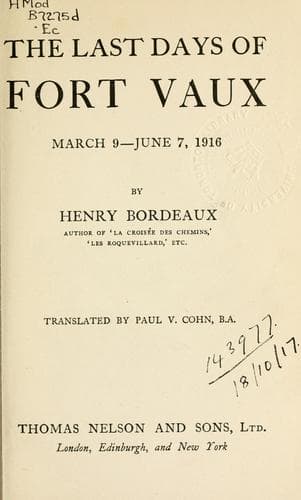
The Last Days of Fort Vaux, March 9-June 7, 1916Bordeaux, Henry
History
The Last Days of Fort Vaux, March 9-June 7, 1916
Bordeaux, Henry
Verdun, Battle of, Verdun, France, 1916; World War, 1914-1918 -- Personal narratives
When the onslaughts upon the entrenchments that he was guarding were
at their height, Captain Delvert admired the pose of a bomb-thrower in
action. A soldier of the 142nd who managed to get away from Fort Vaux,
in describing the attack by flames, gas, and explosive petards, and the
giving way of the door, and the men flying in the air, and the Boches
rushing in, and Lieutenant Bazy barring the corridor to them, cannot
help giving vent to the exclamation, “It was superb!” Cadet Bégouen,
leading his fatigue party under the geysers caused by the shells,
feels sorry that he has not his camera with him. Such are the undying
characteristics of our race, ever in love with beauty, ever desirous,
under the most adverse conditions, of seeing life and realizing it to
the full.
III
THE HARVEST OF THE FUTURE
Vaux is lost, for the time being, but Vaux will be regained, and the
battle of Verdun is being won day by day. Day by day the meaning of the
Verdun battle grows clearer. The infantryman who only knows his trench
mates is an atom of a vast army distributed over all the fronts: his
blood and sweat will mingle in history with the blood and sweat of his
unknown and remote brothers. A scrap of disputed territory, which seems
to the men involved an end in itself, is really nothing but a point in
the vast shifting front where the two great forces of the world are at
grips.
On June 12, five days after the capture of the fort, the
Commander-in-Chief informs the Verdun troops of the Russian victories
in Bukovina and Galicia, through the following Army order:
“The plan matured by the councils of the coalition is now in full
course of being carried out.
“Soldiers of Verdun, it is to your heroic resistance that this
consummation is due. It is this resistance that was the essential
condition, and it is on this resistance that our coming victories
depend; for it was this resistance that has created over the whole
theatre of the European war a situation that will soon bring about the
final triumph of our cause.”
The enemy is now held, and will have to submit to our laws and accept
our manœuvres.
On March 10 the enemy climbs the northern slopes of Fort Vaux. He
is now only two or three hundred yards off the counterscarp. To
cross those two or three hundred yards will take him three months.
Three months of superhuman exertions, of ceaseless attacks, of an
inconceivable outlay of munitions and incredible losses among her young
men, the flower of the nation. Three months, as if the war had no other
object than this.
And during those three months the coalition finishes concerting,
preparing, and carrying out its plans.
Fighting takes place in front of the fort, above and within it, from
June 2 to 7. On the 4th, the first Russian offensive is launched south
of the Pripet. It at once forces Austria to abandon its own offensive
against the Trentino.
Public-domain text, read in full here on John Shaqi.
Reviews
Reviews
No reviews yet
Be the first to share your thoughts on this work.
Elsewhere in the archive
Join the Discussion
Join the discussion
Sign in to leave a comment or review.
Sign InorCreate an account