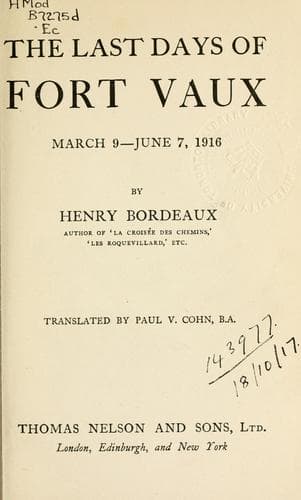
The Last Days of Fort Vaux, March 9-June 7, 1916Bordeaux, Henry
History
The Last Days of Fort Vaux, March 9-June 7, 1916
Bordeaux, Henry
Verdun, Battle of, Verdun, France, 1916; World War, 1914-1918 -- Personal narratives
“All the roads are commanded by the French guns, and their fire
is so incessant that we cannot even bury our dead. It is pitiful
to see the poor devils lying dead in their mud-holes. Every day
some of our men are killed and wounded. It is only by risking
our lives that we can put the wounded in a place of safety. To
get our meals, we have to go over two miles to the rear, to the
travelling field-kitchens, and even there one is in danger of being
killed. Every day there are casualties among those who go for their
rations, so much so that many would rather endure hunger than make
these dangerous expeditions for food. Nearly the whole company is
sick. When you are out in the rain all day and get wet through,
sleep in the mud, and are under a frightful bombardment night
and day, and all this for a week at a time, your nerves become
completely shattered. So far as health is concerned I am still in
fairly good trim. My feet are very wet and cold, and I am fearfully
chilly about the knees. I hope I shall have the luck to get out of
this alive. One cannot even be buried properly here....”
Some answers received from Germany add a few touches to this picture of
the German Army in the Vaux sector.
The following letter, covered with stains, was found on a dead man. It
had been kept in spite of its having been written so long ago:
“COLOGNE, 29/12/1915.
“There is no doubt, my dear Willy, that we are living through very
hard times, and one cannot yet see where it will all end. You tell
me not to believe all that the newspapers say. But do you really
think we believe, as we did at first, in that ‘rollicking mood’
(_Hurrastimmung_) among the men at the front? A year ago we fancied
that we heard the note of warlike enthusiasm in every song that the
soldiers sang. But to-day! Yesterday I happened to be present when
thirty to thirty-five men of the Landsturm were starting off. Five
of them were singing at the top of their voices, ‘Dear Fatherland,
good-bye!’ But these five were so drunk that they had to lean
against each other for support. Some hundred yards behind the group
three policemen were marching and watching them to see that this
enthusiasm was not overdone at the station. When we look at such
scenes and then read the newspaper reports of deeds of valour, do
you imagine that we think only of the latter? Yes, Willy, that’s
what war is like, the ‘beneficent’ war that had to come, the war
that was needed in order that the world should become a better
place to live in. It is strange that after seventeen months of war
I have not yet been able to discover any sign of improvement among
my immediate neighbours!”
On the prisoners these letters were found:
“HEISSEN, _March 24, 1916_.
Public-domain text, read in full here on John Shaqi.
Reviews
Reviews
No reviews yet
Be the first to share your thoughts on this work.
Elsewhere in the archive
Join the Discussion
Join the discussion
Sign in to leave a comment or review.
Sign InorCreate an account