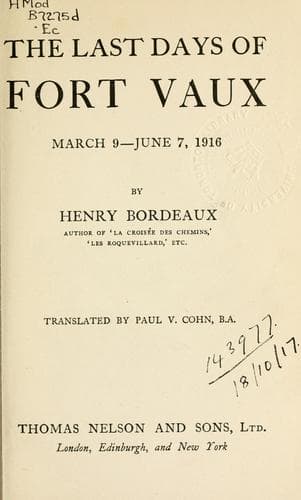
The Last Days of Fort Vaux, March 9-June 7, 1916Bordeaux, Henry
History
The Last Days of Fort Vaux, March 9-June 7, 1916
Bordeaux, Henry
Verdun, Battle of, Verdun, France, 1916; World War, 1914-1918 -- Personal narratives
“It is still better to be at the front than here. We are suffering
terribly from the cold, and have to wait in a queue from morning
till evening, and even then we sometimes come home empty-handed
at the end of the day and having nothing to eat. It is very sad,
but you, my dear Fritz, are holding out in the enemy’s country; we
shall hold out here as well.”
“STRASSBURG (PRUSSIA),
_March 20, 1916_.
“You write to us that you have had to suck snow, so great was your
hunger, yet that was hardly likely to cure your pangs. Yes, my
dear, you have to starve, but do you think things are any better
here?”
These extracts will suffice. What is the use of publishing any more?
Further letters would give us no more information as to the state of
the German soldier before Fort Vaux. We could find enough and to spare
of complaints about economic difficulties. That the German soldier who
is fighting at Verdun should know so much of the material insecurity
of those whom he has left behind him is a righteous punishment for the
terrible scourge let loose by a whole nation drunk with the sense of
power--the nation which sneered when Paris starved in 1870 and which
has set out to organize a war of frightfulness. The fires of its hell
burn hotter and hotter.
To Mont-Mare Wood and Le Prêtre Wood, which lie west of Pont-à-Mousson,
where the plains of the Woevre meet the undulating country of La Haye,
the German soldiers gave the names of Widows’ Wood and Wood of Death
respectively. What will they call the region of Vaux?
It was the 6th Division of the 3rd Corps that attacked the earthwork of
Hardaumont at the beginning of March. The assaults on Vaux village and
fort on March 8, 9, and 10 were delivered by the 9th Reserve Division
of the 5th Corps.
I have quoted, without comment, examinations of prisoners and extracts
from letters. The proof is given by the enemy in person: over the soil
of France which he came to trample upon, our artillery and our infantry
deal him out death in ample measure or, when he escapes death, force
him to lead a somewhat harassed existence. That, no doubt, is what he
calls an “amazingly obstinate” resistance.
Public-domain text, read in full here on John Shaqi.
Reviews
Reviews
No reviews yet
Be the first to share your thoughts on this work.
Elsewhere in the archive
Join the Discussion
Join the discussion
Sign in to leave a comment or review.
Sign InorCreate an account