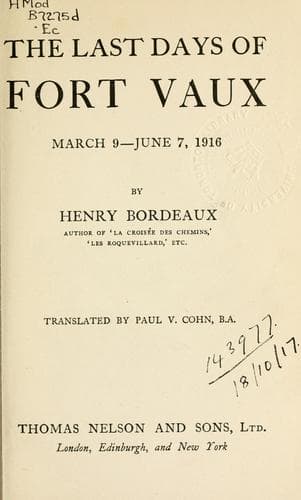
The Last Days of Fort Vaux, March 9-June 7, 1916Bordeaux, Henry
History
The Last Days of Fort Vaux, March 9-June 7, 1916
Bordeaux, Henry
Verdun, Battle of, Verdun, France, 1916; World War, 1914-1918 -- Personal narratives
He will not halt when so near the goal, in spite of this sanguinary
set-back. A battalion takes the place of the one that has been cut
down. At two o’clock in the afternoon comes a fresh onset, which
becomes a long-drawn-out contest, swaying backwards and forwards. The
struggle is a fierce one in the communication passages and half-filled
trenches, an affair of bombs, of bayonets, of hand-to-hand fighting.
At three o’clock, however, the two entrenchments are lost. Not a man
has come back to tell what has happened at the dyke. As to what took
place at R² and R³, occupied by the two platoons, a postcard from their
commander, Lieutenant Gontal, written from a prisoners’ camp to Colonel
Lanusse, commanding the 101st Regiment, brought the news a month later.
I met Colonel Lanusse when he had just arrived at a rest billet, in a
pleasant little village amid the wild dales of the Argonne. He had had
a spell in the trenches; he had left off his jersey on account of the
heat, and was tuning a piano which he had discovered at the house of
one of the villagers. Such a stroke of luck is rare for a music-lover.
A flute and a violin, placed on the table, and also the score of a
classical trio, were awaiting the performers.
“You see,” he said to me, “_musica me juvat_.”
“Or _delectat_,” I countered, in pious recollection of my Latin grammar.
With the same simplicity he drew me a picture of the terrible week
in which his regiment distinguished itself. Lieutenant Gontal’s card
cheered him like a march tune, but did not surprise him in the least.
He was sure that things must have turned out in this way. And whenever
he laid stress on the part played by any one of his officers, he
hastened to do justice to the others. With the exception of himself, he
gave some account of the whole cadre. Here, then, is the testimony of
Lieutenant Gontal, which, in a few laconic words, sums up the defence
of R² and R³:
“Wounded on June 1. Was picked up by the Germans and brought here. We
carried out to the letter the order given: not to draw back an inch on
any pretext. Thus it was that we were cut off, outflanked on all sides,
and overwhelmed by weight of numbers. I was one of the last to fall,
hit right in the stomach by a bullet fired at ten yards’ distance.
Lieutenant Huret had his right arm fractured. Second Lieutenant
Pasquier was wounded. Sergeant-Major Farjon had his right hand crushed
and his left thigh pierced by a bullet. Cadet Tocabens had five shell
splinters in his body. Sergeant Lecocq was killed by a bullet in his
forehead. The rest of the company suffered losses in proportion. This
summary will tell you more than any lengthy comment of the way in which
we understood our duty and satisfied the claims of honour.
“I would draw special attention to the bravery shown by Lieutenant
Huret, Cadet Tocabens, and above all, Sergeant-Major Farjon, who richly
deserves the Military Medal.”
Public-domain text, read in full here on John Shaqi.
Reviews
Reviews
No reviews yet
Be the first to share your thoughts on this work.
Elsewhere in the archive
Join the Discussion
Join the discussion
Sign in to leave a comment or review.
Sign InorCreate an account