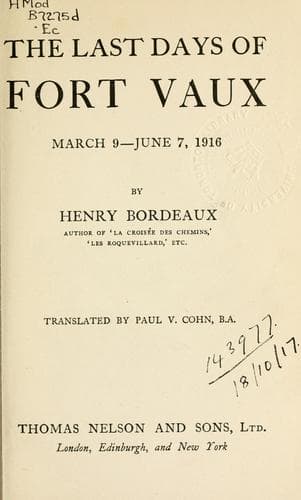
The Last Days of Fort Vaux, March 9-June 7, 1916Bordeaux, Henry
History
The Last Days of Fort Vaux, March 9-June 7, 1916
Bordeaux, Henry
Verdun, Battle of, Verdun, France, 1916; World War, 1914-1918 -- Personal narratives
An officer of the company charged with the defence of the Damloup
battery, Second Lieutenant Brieu, was an eye-witness of the struggle,
and gives the following details: “We see our comrades starting off,
their heads lowered, and jumping from shell-hole to shell-hole. The
Germans, however, have brought up machine-guns, which mow down our poor
_poilus_, and these complete the task of shattering the counter-attack.
In a few minutes the unlucky 11th is wiped out, and Captain Hutinet
and two second lieutenants are brought in to us badly wounded. What is
left of the company goes on fighting, but its effectives are terribly
reduced, and this tiny band comes to take refuge near us. At this
moment Colonel Tahon, being apprised of the state of affairs, orders
us to hold the battery at all costs and to prevent the Boches from
advancing. Captain Cadet strengthens the position with the 4th and the
remnant of the 11th, and also with a machine-gun section. We set to
work energetically, for we realize that the Germans will try to take
the important position that we are occupying. Throughout the day we are
on the alert....”
Thus the counter-attack on the 11th Company of the 142nd Regiment has
been broken by machine-guns set up at the exit from Damloup, scattered
on the bits of roof that have been spared by the bombardments, or
hidden behind the fragments of wall. Must it be started all over again
with more numerous effectives? Pelissier’s battalion of the 52nd is
ready to march; grenades have been handed out to it. But the few hours
that have elapsed have given the enemy an opportunity of entrenching
himself more strongly. Damloup, on the western side, is easier to
defend than to attack. The ravines that skirt it, as far as the
southern slopes, are in the hands of the Germans, and the promontory
that leads to them is narrow. What is more, the reinforcements have
been seen coming from Dieppe, and working parties have been signalled
to the artillery on the western and southern sides of the hill. It
would be preferable to fortify the Damloup battery, the southern slopes
of La Gayette and La Horgne bottoms, and to profit by the darkness of
night in order firmly to consolidate this new line, which may hold its
ground. And our men set to work, while our artillery goes on constantly
dispersing the massed formations of the enemy and peppering the lost
village of Damloup. “The men dig and take cover. The deluge of iron
has opened afresh and lasts the whole night long; there is a deafening
uproar of continual explosions.” Next day, at dawn, the situation has
changed for the better, and our men resolutely await the attacks.
The bombardment which precedes them demolishes the hastily improvised
trenches facing Damloup and overpowers the battery. It is the tocsin
that sets the conflagration going. It is not until three o’clock in
the afternoon that the Germans come up for the assault. At this point I
have recourse to Second Lieutenant Brieu’s narrative:
Public-domain text, read in full here on John Shaqi.
Reviews
Reviews
No reviews yet
Be the first to share your thoughts on this work.
Elsewhere in the archive
Join the Discussion
Join the discussion
Sign in to leave a comment or review.
Sign InorCreate an account