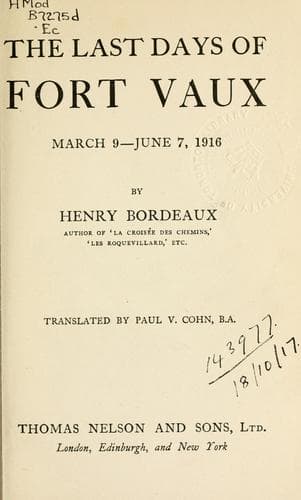
The Last Days of Fort Vaux, March 9-June 7, 1916Bordeaux, Henry
History
The Last Days of Fort Vaux, March 9-June 7, 1916
Bordeaux, Henry
Verdun, Battle of, Verdun, France, 1916; World War, 1914-1918 -- Personal narratives
The afternoon of June 4 passes, but the communications are not
restored. It is impossible to obtain a signal from the fort. Probably
there has been no means of registering the position of its sighting
gear. On the 5th, however, at three o’clock in the morning, the
headquarters of the division see two men arrive. They have issued
from the fort--nothing more than that! They belong to the searchlight
section. As there were no more pigeons and the signals were not
working, they had to come to restore the communications. That is as
plain as a pikestaff.
“So the fort is not encircled?”
“They are on top with a machine-gun, but there is no one at the
southern exit.”
“That exit is stopped up.”
“You jump from a window into the ditch.”
Others have made the attempt, but have not succeeded in escaping. These
two do not furnish many details. For the time being they are too much
absorbed in other matters, for they are professionals. Will the fort
hold out? Life is no laughing matter in the interior on account of
liquid fire and thirst. Then, too, the place is overcrowded: more than
600 men. Yet the morale is good. Up there, they will try once more to
interchange messages.
At half-past seven in the morning Fort Vaux is no longer isolated. It
speaks and receives an answer....
“The mountains are lofty, massive, and dark, the valleys deep, the
torrents swift. Behind and in front of the army the trumpets ring, and
they all seem to reply to the horn....”
But when Charlemagne’s trumpets ring, Roland is already no more.
Imagine him rising up in face of death to listen to those blasts!
Fort Vaux informs the High Command as to the position of the enemy. Its
message rings with hope:
“The enemy is working at the western part of the fort to construct a
mine-chamber and blow up the vault. Strike quickly with artillery.”
Ten minutes later it becomes insistent:
“Where are you?”
At eight o’clock, having had no reply, or having been unable to
decipher it, it confesses the agony of its suspense:
“We do not hear your artillery. The enemy is plying us with gas and
liquid fire attacks. Our situation is as bad as can be.”
At last, at nine o’clock, this signal is transmitted to it: “Don’t lose
heart. We shall soon attack.”
Roland, as he was dying, heard Charlemagne’s trumpets. They are so
distant, but their music is so sweet. He starts up, he listens, he
motions to death to wait awhile. But the French must make haste!
Already the shades are closing in around him and his speech grows thick.
All day the fort waits. When night falls, it shows signs of impatience.
Will not this coming night be the last? will it not be wrapped in its
lethal winding-sheet? The opening of the message that it sends is
unintelligible, the rest already has the tone of a funeral oration--it
speaks of its defenders in the past tense:
Public-domain text, read in full here on John Shaqi.
Reviews
Reviews
No reviews yet
Be the first to share your thoughts on this work.
Elsewhere in the archive
Join the Discussion
Join the discussion
Sign in to leave a comment or review.
Sign InorCreate an account