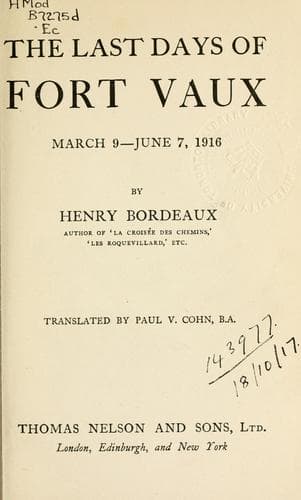
The Last Days of Fort Vaux, March 9-June 7, 1916Bordeaux, Henry
History
The Last Days of Fort Vaux, March 9-June 7, 1916
Bordeaux, Henry
Verdun, Battle of, Verdun, France, 1916; World War, 1914-1918 -- Personal narratives
“I would rather go alone,” he says. “When we get there, things will be
easier if I am alone. Besides, I want entire freedom of movement.”
The Chief of Staff hands him his orders. He reads them, rereads them,
imprints them in his memory and returns the paper, for he must not
carry anything away with him.
Night comes, and he is taken by motor-car as far as motor-cars dare go.
He shakes hands with the officer who is with him, then lightly runs off
into the darkness, where his outline is soon lost.
It has been arranged that, if he re-enters the fort, the searchlight
will end up its next signals with “Long live France!”
At 11.20 P.M. the visual message transmitted from Fort Vaux, after
an opening which the bombardment made it impossible to understand,
contains this phrase: “You will intervene before we are utterly
exhausted. Long live France!”
V
THE LAST WORDS
The effort to extricate Vaux has not been relaxed for a moment, but the
German attacks and ours succeed each other, dash against each other,
anticipate each other, cancel each other. Neither side contrives to
forge ahead. On the right, the enemy is unable to debouch from Damloup,
and spends his strength in vain against the battery. On the left, his
way is blocked in Fumin Wood, and R¹ continues to withstand him. The
battle drags along in the hard-pressed, flame-ravaged, starving fort,
where the energy of a handful of men makes the resistance seem likely
to last for ever. But we cannot retake the external earthworks, which
bristle with machine-guns. The whole tableland and its slopes are swept
to such an extent that the ground is like a mass of cinders.
In the course of the morning of June 6, we might have fancied for a
moment that we once more held the whole fort and that the garrison
was delivered. An attack had been prepared, and was to open at two
o’clock. At four, a German pioneer of the 27th Regiment was brought
into divisional headquarters, scared out of his wits, his uniform in
rags. He was found in our lines, without weapons, wild-eyed, running
breathlessly. On being examined, he stated that he had escaped from
Fort Vaux when the French surrounded it.
The attack was to approach the fort by its three fronts: towards the
western front, a company of the 238th; towards the gorge, another
company of the same regiment and a section of engineers, commanded by
Major Mathieu; finally, towards the eastern front, two companies of
the 321st, commanded by Major Favre. The signal was to be given at two
o’clock in the morning by a series of rockets.
Public-domain text, read in full here on John Shaqi.
Reviews
Reviews
No reviews yet
Be the first to share your thoughts on this work.
Elsewhere in the archive
Join the Discussion
Join the discussion
Sign in to leave a comment or review.
Sign InorCreate an account