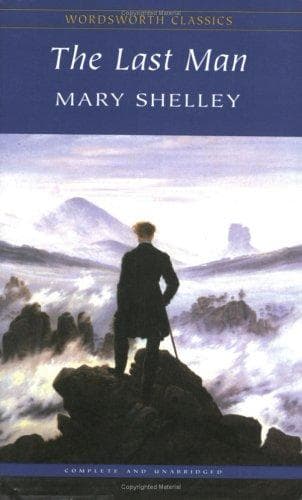
End of the world -- Fiction; Epidemics -- Fiction; Science fiction; Twenty-first century -- Fiction
We had lived so long in the vicinity of Eton, that its population of
young folks was well known to us. Many of them had been Alfred’s
playmates, before they became his school-fellows. We now watched this
youthful congregation with redoubled interest. We marked the difference
of character among the boys, and endeavoured to read the future man in
the stripling. There is nothing more lovely, to which the heart more
yearns than a free-spirited boy, gentle, brave, and generous. Several
of the Etonians had these characteristics; all were distinguished by a
sense of honour, and spirit of enterprize; in some, as they verged
towards manhood, this degenerated into presumption; but the younger
ones, lads a little older than our own, were conspicuous for their
gallant and sweet dispositions.
Here were the future governors of England; the men, who, when our
ardour was cold, and our projects completed or destroyed for ever,
when, our drama acted, we doffed the garb of the hour, and assumed the
uniform of age, or of more equalizing death; here were the beings who
were to carry on the vast machine of society; here were the lovers,
husbands, fathers; here the landlord, the politician, the soldier; some
fancied that they were even now ready to appear on the stage, eager to
make one among the dramatis personae of active life. It was not long
since I was like one of these beardless aspirants; when my boy shall
have obtained the place I now hold, I shall have tottered into a
grey-headed, wrinkled old man. Strange system! riddle of the Sphynx,
most awe-striking! that thus man remains, while we the individuals pass
away. Such is, to borrow the words of an eloquent and philosophic
writer, “the mode of existence decreed to a permanent body composed of
transitory parts; wherein, by the disposition of a stupendous wisdom,
moulding together the great mysterious incorporation of the human race,
the whole, at one time, is never old, or middle-aged, or young, but, in
a condition of unchangeable constancy, moves on through the varied
tenour of perpetual decay, fall, renovation, and progression.”[5]
Public-domain text, read in full here on John Shaqi.
Reviews
Reviews
No reviews yet
Be the first to share your thoughts on this work.
Elsewhere in the archive
Join the Discussion
Join the discussion
Sign in to leave a comment or review.
Sign InorCreate an account