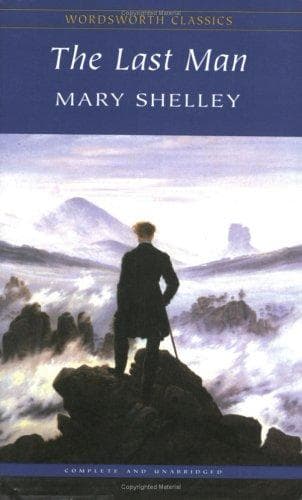
End of the world -- Fiction; Epidemics -- Fiction; Science fiction; Twenty-first century -- Fiction
I rambled on, oppressed, distracted by painful emotions—suddenly I
found myself before Drury Lane Theatre. The play was Macbeth—the first
actor of the age was there to exert his powers to drug with
irreflection the auditors; such a medicine I yearned for, so I entered.
The theatre was tolerably well filled. Shakspeare, whose popularity was
established by the approval of four centuries, had not lost his
influence even at this dread period; but was still “Ut magus,” the
wizard to rule our hearts and govern our imaginations. I came in during
the interval between the third and fourth act. I looked round on the
audience; the females were mostly of the lower classes, but the men
were of all ranks, come hither to forget awhile the protracted scenes
of wretchedness, which awaited them at their miserable homes. The
curtain drew up, and the stage presented the scene of the witches’
cave. The wildness and supernatural machinery of Macbeth, was a pledge
that it could contain little directly connected with our present
circumstances. Great pains had been taken in the scenery to give the
semblance of reality to the impossible. The extreme darkness of the
stage, whose only light was received from the fire under the cauldron,
joined to a kind of mist that floated about it, rendered the unearthly
shapes of the witches obscure and shadowy. It was not three decrepid
old hags that bent over their pot throwing in the grim ingredients of
the magic charm, but forms frightful, unreal, and fanciful. The
entrance of Hecate, and the wild music that followed, took us out of
this world. The cavern shape the stage assumed, the beetling rocks, the
glare of the fire, the misty shades that crossed the scene at times,
the music in harmony with all witch-like fancies, permitted the
imagination to revel, without fear of contradiction, or reproof from
reason or the heart. The entrance of Macbeth did not destroy the
illusion, for he was actuated by the same feelings that inspired us,
and while the work of magic proceeded we sympathized in his wonder and
his daring, and gave ourselves up with our whole souls to the influence
of scenic delusion. I felt the beneficial result of such excitement, in
a renewal of those pleasing flights of fancy to which I had long been a
stranger. The effect of this scene of incantation communicated a
portion of its power to that which followed. We forgot that Malcolm and
Macduff were mere human beings, acted upon by such simple passions as
warmed our own breasts. By slow degrees however we were drawn to the
real interest of the scene. A shudder like the swift passing of an
electric shock ran through the house, when Rosse exclaimed, in answer
to “Stands Scotland where it did?”
Public-domain text, read in full here on John Shaqi.
Reviews
Reviews
No reviews yet
Be the first to share your thoughts on this work.
Elsewhere in the archive
Join the Discussion
Join the discussion
Sign in to leave a comment or review.
Sign InorCreate an account