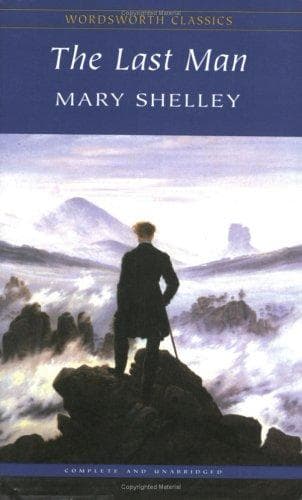
End of the world -- Fiction; Epidemics -- Fiction; Science fiction; Twenty-first century -- Fiction
It was my task each day to visit the various families assembled in our
town, and when the weather permitted, I was glad to prolong my ride,
and to muse in solitude over every changeful appearance of our destiny,
endeavouring to gather lessons for the future from the experience of
the past. The impatience with which, while in society, the ills that
afflicted my species inspired me, were softened by loneliness, when
individual suffering was merged in the general calamity, strange to
say, less afflicting to contemplate. Thus often, pushing my way with
difficulty through the narrow snow-blocked town, I crossed the bridge
and passed through Eton. No youthful congregation of gallant-hearted
boys thronged the portal of the college; sad silence pervaded the busy
school-room and noisy playground. I extended my ride towards Salt Hill,
on every side impeded by the snow. Were those the fertile fields I
loved—was that the interchange of gentle upland and cultivated dale,
once covered with waving corn, diversified by stately trees, watered by
the meandering Thames? One sheet of white covered it, while bitter
recollection told me that cold as the winter-clothed earth, were the
hearts of the inhabitants. I met troops of horses, herds of cattle,
flocks of sheep, wandering at will; here throwing down a hay-rick, and
nestling from cold in its heart, which afforded them shelter and
food—there having taken possession of a vacant cottage. Once on a
frosty day, pushed on by restless unsatisfying reflections, I sought a
favourite haunt, a little wood not far distant from Salt Hill. A
bubbling spring prattles over stones on one side, and a plantation of a
few elms and beeches, hardly deserve, and yet continue the name of
wood. This spot had for me peculiar charms. It had been a favourite
resort of Adrian; it was secluded; and he often said that in boyhood,
his happiest hours were spent here; having escaped the stately bondage
of his mother, he sat on the rough hewn steps that led to the spring,
now reading a favourite book, now musing, with speculation beyond his
years, on the still unravelled skein of morals or metaphysics. A
melancholy foreboding assured me that I should never see this place
more; so with careful thought, I noted each tree, every winding of the
streamlet and irregularity of the soil, that I might better call up its
idea in absence. A robin red-breast dropt from the frosty branches of
the trees, upon the congealed rivulet; its panting breast and
half-closed eyes shewed that it was dying: a hawk appeared in the air;
sudden fear seized the little creature; it exerted its last strength,
throwing itself on its back, raising its talons in impotent defence
against its powerful enemy. I took it up and placed it in my breast. I
fed it with a few crumbs from a biscuit; by degrees it revived; its
warm fluttering heart beat against me; I cannot tell why I detail this
trifling incident—but the scene is still before me; the snow-clad
Public-domain text, read in full here on John Shaqi.
Reviews
Reviews
No reviews yet
Be the first to share your thoughts on this work.
Elsewhere in the archive
Join the Discussion
Join the discussion
Sign in to leave a comment or review.
Sign InorCreate an account