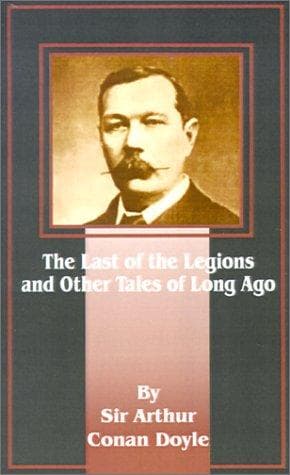
The Last of the Legions and Other Tales of Long AgoDoyle, Arthur Conan
General
The Last of the Legions and Other Tales of Long Ago
Doyle, Arthur Conan
Adventure stories, English; Historical fiction, English; Short stories, English
"That is but cold comfort," said the priest. "It is, indeed, a great
prize which can be worth ten years of a man's life."
"I would give," the Greek answered, "not ten years but all my life if I
could but lay proud Ilium in ashes and carry back Helen to her palace on
the hill of Argos."
"I pray Baal, whose priest I am, that you may have good fortune," said
the Phœnician. "I have heard that these Trojans are stout soldiers, and
that Hector, the son of Priam, is a mighty leader."
The Greek smiled proudly.
"They must be stout and well-fed also," said he, "if they can stand the
brunt against the long-haired Argives with such captains as Agamemnon,
the son of Atreus from golden Mycenæ, or Achilles, son of Peleus, with
his myrmidons. But these things are on the knees of the Fates. In the
meantime, my friend, I would fain know who these strange people are who
come down the street, for their chieftain has the air of one who is made
for great deeds."
A tall man clad in a long white robe, with a golden fillet running
through his flowing auburn hair, was striding down the street with the
free elastic gait of one who has lived an active life in the open. His
face was ruddy and noble, with a short, crisp beard covering a strong,
square jaw. In his clear blue eyes as he looked at the evening sky and
the busy waters beneath him there was something of the exaltation of the
poet, while a youth walking beside him and carrying a harp hinted at the
graces of music. On the other side of him, however, a second squire bore
a brazen shield and a heavy spear, so that his master might never be
caught unawares by his enemies. In his train there came a tumultuous
rabble of dark hawk-like men, armed to the teeth, and peering about with
covetous eyes at the signs of wealth which lay in profusion around them.
They were swarthy as Arabs, and yet they were better clad and better
armed than the wild children of the desert.
"They are but barbarians," said the priest. "He is a small king from the
mountain parts opposite Philistia, and he comes here because he is
building up the town of Jebus, which he means to be his chief city. It
is only here that he can find the wood, and stone, and craftsmanship
that he desires. The youth with the harp is his son. But I pray you,
chief, if you would know what is before you at Troy, to come now into
the outer hall of the Temple with me, for we have there a famous seer,
the prophetess Alaga who is also the priestess of Ashtaroth. It may be
that she can do for you what she has done for many others, and send you
forth from Tyre in your hollow ships with a better heart than you came."
Public-domain text, read in full here on John Shaqi.
Reviews
Reviews
No reviews yet
Be the first to share your thoughts on this work.
Elsewhere in the archive
Join the Discussion
Join the discussion
Sign in to leave a comment or review.
Sign InorCreate an account