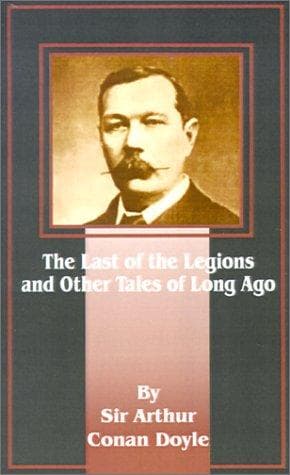
The Last of the Legions and Other Tales of Long AgoDoyle, Arthur Conan
General
The Last of the Legions and Other Tales of Long Ago
Doyle, Arthur Conan
Adventure stories, English; Historical fiction, English; Short stories, English
"Indifferently well," said the other. "Yet I should understand it seeing
that I spent a long year at Ziklag in the land of the Philistines."
"It would seem," said the Greek, "that the gods have chosen us both to
play a part in the world."
"Stranger," the barbarian answered, "there is but one God."
"Say you so? Well, it is a matter to be argued at some better time. But
I would fain have your name and style and what is it you purpose to do,
so that we may perchance hear of each other in the years to come. For my
part I am Odysseus, known also as Ulysses, the King of Ithaca, with the
good Laertes as my father and young Telemachus as my son. For my work,
it is the taking of Troy."
"And my work," said the barbarian, "is the building of Jebus, which now
we call Jerusalem. Our ways lie separate, but it may come back to your
memory that you have crossed the path of David, second King of the
Hebrews, together with his young son Solomon, who may follow him upon
the throne of Israel."
So he turned and went forth into the darkened streets where his spearmen
were awaiting him, while the Greek passed down to his boat that he might
see what was still to be done ere he could set forth upon his voyage.
XIII
THE CENTURION
[_Being the fragment of a letter from Sulpicius Balbus, Legate of the
Tenth Legion, to his uncle, Lucius Piso, in his villa near Baiae, dated
The Kalends of the month of Augustus in the year 824 of Rome._]
I promised you, my dear uncle, that I would tell you anything of
interest concerning the siege of Jerusalem; but, indeed, these people
whom we imagined to be unwarlike have kept us so busy that there has
been little time for letter-writing. We came to Judæa thinking that a
mere blowing of trumpets and a shout would finish the affair, and
picturing a splendid triumph in the _via sacra_ to follow, with all the
girls in Rome throwing flowers and kisses to us. Well, we may get our
triumph, and possibly the kisses also, but I can assure you that not
even you who have seen such hard service on the Rhine can ever have
experienced a more severe campaign than this has been. We have now won
the town, and to-day their temple is burning, and the smoke sets me
coughing as I sit writing in my tent. But it has been a terrible
business, and I am sure none of us wish to see Judæa again.
In fighting the Gauls, or the Germans, you are against brave men,
animated by the love of their country. This passion acts more, however,
upon some than others, so that the whole army is not equally inflamed by
it. These Jews, however, besides their love of country, which is very
strong, have a desperate religious fervour, which gives them a fury in
battle such as none of us have ever seen. They throw themselves with a
shriek of joy upon our swords and lances, as if death were all that they
desired.
Public-domain text, read in full here on John Shaqi.
Reviews
Reviews
No reviews yet
Be the first to share your thoughts on this work.
Elsewhere in the archive
Join the Discussion
Join the discussion
Sign in to leave a comment or review.
Sign InorCreate an account