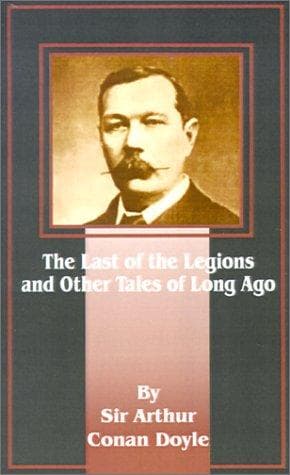
The Last of the Legions and Other Tales of Long AgoDoyle, Arthur Conan
General
The Last of the Legions and Other Tales of Long Ago
Doyle, Arthur Conan
Adventure stories, English; Historical fiction, English; Short stories, English
As I stood in the darkness, wrapped in my scarlet chlamys--for the
evenings here are chill--I was suddenly aware that I was not alone. A
tall, silent figure was near me, looking down at the town even as I was.
I could see in the moonlight that he was clad as an officer, and as I
approached him I recognized that it was Longinus, third tribune of my
own legion, and a soldier of great age and experience. He is a strange,
silent man, who is respected by all, but understood by none, for he
keeps his own council and thinks rather than talks. As I approached him
the first flames burst from the temple, a high column of fire, which
cast a glow upon our faces and gleamed upon our armour. In this red
light I saw that the gaunt face of my companion was set like iron.
"At last!" said he. "At last!"
He was speaking to himself rather than to me, for he started and seemed
confused when I asked him what he meant.
"I have long thought that evil would come to the place," said he. "Now
I see that it has come, and so I said 'At last!'"
"For that matter," I answered, "we have all seen that evil would come to
the place, since it has again and again defied the authority of the
Cæsars."
He looked keenly at me with a question in his eyes. Then he said:
"I have heard, sir, that you are one who has a full sympathy in the
matter of the gods, believing that every man should worship according to
his own conscience and belief."
I answered that I was a Stoic of the school of Seneca, who held that
this world is a small matter and that we should care little for its
fortunes, but develop within ourselves a contempt for all but the
highest.
He smiled in grim fashion at this.
"I have heard," said he, "that Seneca died the richest man in all Nero's
Empire, so he made the best of this world in spite of his philosophy."
"What are your own beliefs?" I asked. "Are you, perhaps, one who has
fathomed the mysteries of Isis, or been admitted to the Society of
Mythra?"
"Have you ever heard," he asked, "of the Christians?"
"Yes," said I. "There were some slaves and wandering men in Rome who
called themselves such. They worshipped, so far as I could gather, some
man who died over here in Judæa. He was put to death, I believe, in the
time of Tiberius."
"That is so," he answered. "It was at the time when Pilate was
procurator--Pontius Pilate, the brother of old Lucius Pilate, who had
Egypt in the time of Augustus. Pilate was of two minds in the matter,
but the mob was as wild and savage as these very men that we have been
contending with. Pilate tried to put them off with a criminal, hoping
that so long as they had blood they would be satisfied. But they chose
the other, and he was not strong enough to withstand them. Ah! it was a
pity--a sad pity!"
"You seem to know a good deal about it," said I.
Public-domain text, read in full here on John Shaqi.
Reviews
Reviews
No reviews yet
Be the first to share your thoughts on this work.
Elsewhere in the archive
Join the Discussion
Join the discussion
Sign in to leave a comment or review.
Sign InorCreate an account