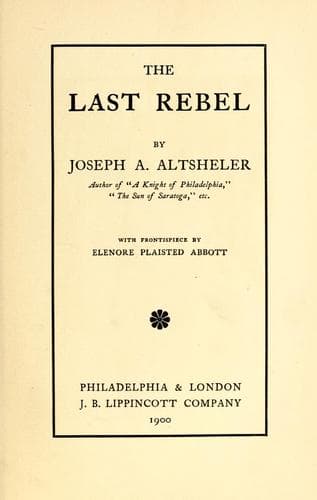
The Last RebelAltsheler, Joseph A. (Joseph Alexander)
History
The Last Rebel
Altsheler, Joseph A. (Joseph Alexander)
Prisoners -- Fiction; United States -- History -- Civil War, 1861-1865 -- Fiction
We sat again in the great drawing-room at Fort Defiance. The military
appearance of the apartment was unchanged. The portraits of the
Confederate generals looked from wall to wall at each other. The bright
sun, reflected from the snow outside, gleamed on the burnished arms. At
the head of the table sat the colonel, in his most brilliant uniform,
stiff and precise as a judge should be. Dr. Ambrose at the side of the
table took their statements in writing, and six men in Confederate
gray, Crothers at their head, listened attentively to the evidence.
Thus my second trial on the charge of being a Yankee spy, appealed on
a writ of error from the first, drew to its end.
Miss Hetherill sat beside the window. Streaks of dim gold showed in her
dark hair where the winter sunshine fell across it. When her eyes met
mine a bit of a smile appeared in them, and the delicate color in her
cheeks deepened.
The last evidence was given, and the colonel directed the military jury
to retire to the next room and consider a verdict. When they had gone
we waited in silence. The snow-birds hopped about outside. One of them
perched on the window-sill and stared at us through the glass for a
moment. Then he flew away. The snow on the knife-edge of the distant
mountain ridges shone like gold under the sun.
The jury returned, Crothers at their head.
"What is your verdict, gentlemen?" asked the colonel.
"Not guilty," replied Crothers. "It is our unanimous decision."
"I am glad of it," said the colonel. "It is my opinion too. Mr. West,
my congratulations and sympathy as from one honest enemy to another."
He reached over and gave my hand a strong and friendly grasp.
"Remember," he said, "that until we return you to your own country you
are our guest in the fullest sense of the word."
Dr. Ambrose and Crothers also shook my hand, and everybody seemed to be
glad that we had arrived at the truth at last.
By and by, only Grace and I were left in the room. We stood by the
great window; the brilliant sunlight reflected from the snow threw a
broad band of gold across the floor. Her face, for the first time since
I knew her, seemed peaceful and content.
The snow-birds hopped from one little white mound to another, like
their brethren of the summer passing from flower to flower. Three or
four flew to the brave little brass cannon which menaced the passage of
the drawbridge, and perched upon its barrel.
"They don't seem to fear the dogs of war," I said.
"They need not," said Grace. "Our cannon will never be used again; the
last salute cracked the barrel all the way."
"Do you forgive me," I asked, asking the old question, "for bringing so
much trouble upon Fort Defiance?"
"There is nothing to forgive," she said, earnestly. "It was no fault of
yours."
I became brave.
"Then you are not sorry I came?"
"No."
I took her hands in mine.
"You are sorry I am going?"
"Yes."
I kissed her for the second time in my life.
Public-domain text, read in full here on John Shaqi.
Reviews
Reviews
No reviews yet
Be the first to share your thoughts on this work.
Elsewhere in the archive
Join the Discussion
Join the discussion
Sign in to leave a comment or review.
Sign InorCreate an account