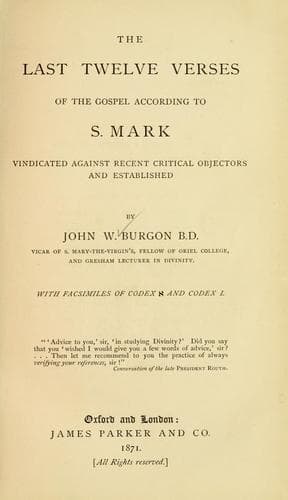
The Last Twelve Verses of the Gospel According to S. MarkBurgon, John William
Religion
The Last Twelve Verses of the Gospel According to S. Mark
Burgon, John William
Bible. Mark XVI, 9-20 -- Criticism, Textual
It was even to have been expected, from what is found to have been
universally the method in other parts of Scripture,—(for it was of course
foreseen by ALMIGHTY GOD from the beginning that this portion of His Word
would be, like its Divine Author, in these last days cavilled at, reviled,
hated, rejected, denied,)—that the SPIRIT would not leave Himself without
witness in this place. It was to have been anticipated, I say, that
Eternal Wisdom would carefully—(I trust there is no irreverence in so
speaking of GOD and His ways!)—would carefully make provision: meet the
coming unbelief (as His Angel met Balaam) with a drawn sword: plant up and
down throughout these Twelve Verses of the Gospel, sure indications of
their Divine Original,—unmistakable notes of purpose and
design,—mysterious traces and tokens of Himself; not visible indeed to the
scornful and arrogant, the impatient and irreverent; yet clear as if
written with a sunbeam to the patient and humble student, the man who
“trembleth at GOD’S Word.”(313) Or, (if the Reader prefers the image,) the
indications of a Divine Original to be met with in these verses shall be
likened rather to those cryptic characters, invisible so long as they
remain unsuspected, but which shine forth clear and strong when exposed to
the Light or to the Heat; (Light and Heat, both emblems of Himself!) so
that even he that gropeth in darkness must now see them, and admit that of
a truth “the LORD is in this place” although he “knew it not!”
(i.) I propose then that in the first instance we compare the conclusion
of S. Mark’s Gospel with the beginning of it. We did this before, when our
object was to ascertain whether the _Style_ of S. Mark xvi. 9-20 be indeed
as utterly discordant from that of the rest of the Gospel as is commonly
represented. We found, instead, the most striking resemblance.(314) We
also instituted a brief comparison between the two in order to discover
whether the _Diction_ of the one might not possibly be found as suggestive
of _verbal_ doubts as the diction of the other: and so we found
it.(315)—Let us for the third time draw the two extremities of this
precious fabric into close proximity in order again to compare them.
Nothing I presume can be fairer than to elect that, once more, our
attention be chiefly directed to what is contained within the twelve
verses (ver. 9-20) of S. Mark’s _first_ chapter which exactly correspond
with the twelve verses of his _last_ chapter (ver. 9-20) which are the
subject of the present volume.
Now between these two sections of the Gospel, besides (1) the obvious
_verbal_ resemblance, I detect (2) a singular parallelism of _essential
structure_. And this does not strike me the less forcibly because nothing
of the kind was to have been _expected_.
(1.) On the verbal coincidences I do not propose to lay much stress. Yet
are they certainly not without argumentative weight and significancy. I
allude to the following:—
Public-domain text, read in full here on John Shaqi.
Reviews
Reviews
No reviews yet
Be the first to share your thoughts on this work.
Elsewhere in the archive
Join the Discussion
Join the discussion
Sign in to leave a comment or review.
Sign InorCreate an account