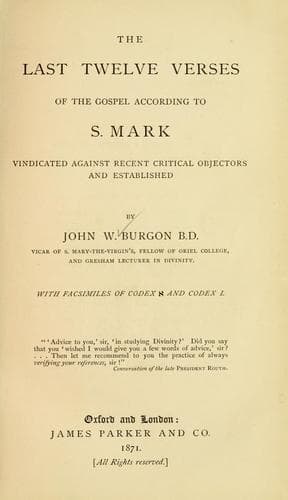
The Last Twelve Verses of the Gospel According to S. MarkBurgon, John William
Religion
The Last Twelve Verses of the Gospel According to S. Mark
Burgon, John William
Bible. Mark XVI, 9-20 -- Criticism, Textual
2. Whether certain ancient Critics, because it was acceptable to them,
were not found to promote this mistake,—it is useless to inquire. That
there may have arisen some old harmonizer of the Gospels, who, (in the
words of Eusebius,) was disposed to “regard what followed as superfluous
from its seeming inconsistency with the testimony of the other
Evangelists;”(456)—and that in this way the error became propagated;—is
likely enough. But an error it most certainly was: and to that _error_,
the _accident_ described in the last preceding paragraph _would have_ very
materially conduced, and it may have very easily done so.
3. I request however that it may be observed that the “accident” is not
_needed_ in order to account for the “error.” The mere presence of ΤΟ
ΤΕΛΟΣ at ver. 8, so near the end of the Gospel, would be quite enough to
occasion it. And we have seen that in very ancient times the word ΤΕΛΟΣ
frequently _did_ occur in an altogether exceptional manner in that very
place. Moreover, we have ascertained that its meaning was _not understood_
by the transcribers of ancient MSS.
4. And will any one venture to maintain that it is to him a thing
incredible that an intelligent copyist of the iiird century, because he
read the words ΤΟ ΤΕΛΟΣ at S. Mark xvi. 8, can have been beguiled thereby
into the supposition that those words indicated “the End” of _S. Mark’s
Gospel_?—Shall I be told that, even if _one_ can have so entirely
overlooked the meaning of the liturgical sign as to suffer it to insinuate
itself into his text,(457) it is nevertheless so improbable as to pass all
credence that _another_ can have supposed that it designated _the
termination of the Gospel_ of the second Evangelist?—For all reply, I take
leave to point out that Scholz, and Tischendorf, and Tregelles, and Mai
and the rest of the Critics have, _one and all, without exception,
misunderstood the same word occurring in the same place, and in precisely
the same way_.
Yes. The forgotten inadvertence of a solitary Scribe in the _second_ or
_third_ century has been, _in the nineteenth_, deliberately reproduced,
adopted, and stereotyped by every Critic and every Editor of the New
Testament in turn.
Public-domain text, read in full here on John Shaqi.
Reviews
Reviews
No reviews yet
Be the first to share your thoughts on this work.
Elsewhere in the archive
Join the Discussion
Join the discussion
Sign in to leave a comment or review.
Sign InorCreate an account