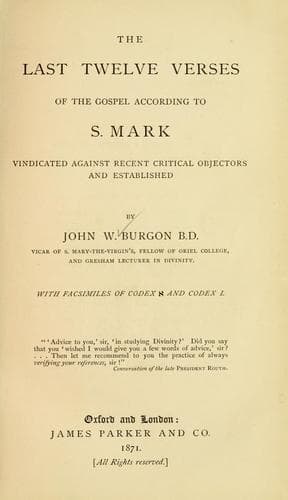
The Last Twelve Verses of the Gospel According to S. MarkBurgon, John William
Religion
The Last Twelve Verses of the Gospel According to S. Mark
Burgon, John William
Bible. Mark XVI, 9-20 -- Criticism, Textual
It is at all events certain that the correctest notion of the use and the
value of the Eusebian Sections will be obtained by one who will be at the
pains to substitute for _the Eusebian Numbers_ in the margin of a copy of
the Greek Gospels _the References_ which these numbers severally indicate.
It will then become plain that the system of Sections and Canons which
Eusebius invented,—ingenious, interesting, and useful as it certainly is;
highly important also, as being the known work of an illustrious Father of
the Church, as well as most precious occasionally for critical
purposes,(545)—is nothing else but a clumsy substitute for what is
achieved by an ordinary “Reference Bible”:—participating in every
inconvenience incidental to the unskilfully contrived apparatus with which
English readers are familiar,(546) and yet inferior in the following four
respects:—
(1st.) The references of Eusebius, (except those found in Canon X.),
require in every instance to be _deciphered_, before they can be verified;
and they can only be deciphered by making search, (and sometimes laborious
search,) in another part of the volume. They are not, in fact, (nor do
they pretend to be,) references to the inspired Text at all; but only
_references to the Eusebian Canons_.
(2ndly.) In their scope, they are of course strictly _confined to the
Gospels_,—which most inconveniently limits their use, as well as
diminishes their value. (Thus, by no possibility is Eusebius able to refer
a reader from S. Luke xxii. 19, 20 to 1 Cor. xi. 23-25.)
(3rdly.) By the very nature of their constitution, reference even to
_another part of the same Gospel_ is impossible. (Eusebius is unable, for
example, to refer a reader from S. John xix. 39, to iii. 1 and vii. 50.)
But besides the preceding, which are disadvantages inherent in the scheme
and inseparable from it, it will be found (4thly), That Eusebius, while he
introduces not a few wholly undesirable references, (of which some
specimens are supplied above), is observed occasionally to withhold
references which cannot by any means be dispensed with. Thus, he omits to
refer his reader from S. Luke’s account of the visit to the Sepulchre
(chap. xxiv. 12) to S. John’s memorable account of the same transaction
(chap. xx. 3-10): _not_ because he disallowed the verse in S. Luke’s
Gospel,—for in a certain place _he discusses its statements_.(547)
Public-domain text, read in full here on John Shaqi.
Reviews
Reviews
No reviews yet
Be the first to share your thoughts on this work.
Elsewhere in the archive
Join the Discussion
Join the discussion
Sign in to leave a comment or review.
Sign InorCreate an account