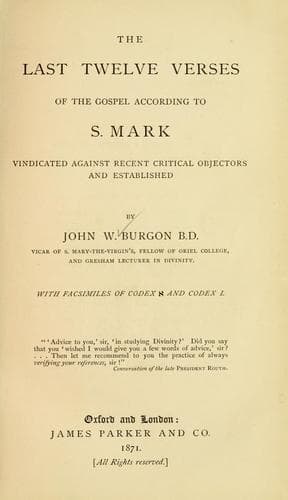
The Last Twelve Verses of the Gospel According to S. MarkBurgon, John William
Religion
The Last Twelve Verses of the Gospel According to S. Mark
Burgon, John William
Bible. Mark XVI, 9-20 -- Criticism, Textual
162 Προσέθετο δὲ ἐν τῷ ἰδίῳ Ἀποστολικῷ καλουμένῳ καὶ τῆς καλουμένης πρὸς
Λαοδικέας:—“Εῖς Κύριος, μία πίστις, ἕν βάπτισμα, εἶς Χριστὸς, εἶς
Θεὸς, καὶ Πατὴρ πάντων, ὁ ἐπὶ πάντων καὶ διὰ πάντων καὶ ἐν πᾶσιν.”
(Epiphan. _Opp._ vol i. p. 374.) Here is obviously a hint of τριῶν
ἀνάρχων ἀρχῶν διαφορὰς πρὸς ἀλλήλας ἐξουσῶν: [Μαρκίωνος γὰρ τοῦ
ματαιόφρονος δίδαγμα, εἰς τρεῖς ἀρχὰς τῆς μοναρχίας τομὴν καὶ
διαίρεσιν. Athanas. i. 231 E.] but, (says Epiphanius), οὐχ οὕτως
ἔχει ἡ τοῦ ἁγίου Ἀποστόλου ὑπόθεσις καὶ ἠσφαλισμένον κήρυγμα. ἀλλὰ
ἄλλως παρὰ τὸ σὸν ποιήτευμα. Then he contrasts with the
“fabrication” of Marcion, the inspired verity,—Eph. iv. 5: declaring
ἕνα Θεὸν, τὸν αὐτὸν πατέρα πάντων,—τὸν αὐτὸν ἐπὶ πάντων, καὶ ἐν
πᾶσι, κ.τ.λ.—p. 374 C.
Epiphanius reproaches Marcion with having obtained materials ἐκτὸς
τοῦ Εὐαγγελίου καὶ τοῦ Ἀποστόλου; οὐ γὰρ ἔδοξε τῷ ἐλεεινοτάτῳ
Μαρκίωνι ἀπὸ τῆς πρὸς Ἐφεσίους ταύτην τὴν μαρτυρίαν λέγειν, (sc. the
words quoted above,) ἀλλὰ τῆς πρὸς Λαοδικέας, τῆς μὴ οὔσης ἐν τῷ
Ἀποστόλῳ (p. 375 A.) (Epiphanius here uses Ἀπόστολος in its
technical sense,—viz. as synonymous with S. Paul’s Epistles.)
163 “Ὠριγένης δέ φησι,—”Ἐπὶ μόνων Ἐφεσίων εὕρομεν κείμενον τὸ “τοῖς
ἁγίοις τοῖς οὖσι;” καὶ ζητοῦμεν, εἰ μὴ παρέλκει προσκείμενον τὸ
“τοῖς ἁγίοις τοῖς οὖσι,” τί δύναται σημαίνειν; ὅρα οὖν εἰ μὴ ὥσπερ
ἐν τῇ Ἐξόδω ὄνομά φησιν ἑαυτοῦ ὁ χρηματίζων Μωσεί τὸ ὬΝ οὕτως οἱ
μετέχοντες τοῦ ὄντος γίνονται “ὄντες.” καλούμενοι οἱονεὶ ἐκ τοῦ μὴ
εἶς αι εἰς τὸ εἶναι. “ἐξελέξατο γὰρ ὁ Θεὸς τὰ μὴ ὄντα,” φησὶν ὁ
αὐτὸς Παῦλος, “ἵνα τὰ ὄντα καταργήση.”—Cramer’s _Catena in Ephes._
i. 1,—vol. vi. p. 102.
164 Consider S. John i. 42, 44, 46: v. 14: ix. 35: xii. 14, &c.
165 Ἀλλὰ καὶ τοῖς Ἐφεσίοις ἐπιστέλλων ὡς γνησίως ἡνωμένοις τῷ Ὄντι δι᾽
ἐπιγνώσεως, “ὄντας” αὐτοὺς ἰδιαζόντως ὠνόμασεν, εἰπών: “τοῖς ἀγίοις
τοῖς οὖσι, καὶ πιστοῖς ἐν Χριστῷ Ἰησοῦ.” οὕτω γὰρ καὶ οἱ πρὸ ἡμῶν
παραδεδώκασι, καὶ ἡμεῖς ἐν τοῖς παλαιοῖς τῶν ἀντιγράφων εὑρήκαμεν.
Note also what immediately follows. (Basil _Opp._ i. p. 254 E, 255
A.)
166 See the places quoted by Scrivener, _Introd._ pp. 381-91;
particularly p. 385.
167 Hieron. _Opp._ vol. vii. p. 543:—“Illud quoque in Præfatione
commoneo, ut sciatis Origenem tria volumina in hanc Epistolam
conscripsisse, quem et nos ex parte sequuti sumus.”
168 “Quidam curiosius quam necesse est putant ex eo quod Moysi dictum
est ‘Haec dices filiis Israel, QUI EST misit me,’ etiam eos qui
Ephesi sunt [Note this. Cf. ‘qui sunt Ephesi,’ _Vulg._] sancti et
fideles, essentiae vocabulo nuncupatos: ut ... ab EO ‘qui est,’ hi
‘qui sunt’ appellentur.... Alii veto simpliciter, non ad eos ‘qui
sint,’ sed ‘qui Ephesi sancti et fideles sint’ scriptum
arbitrantur.” Hieron. _Opp._ vii. p. 545 A, B.
Public-domain text, read in full here on John Shaqi.
Reviews
Reviews
No reviews yet
Be the first to share your thoughts on this work.
Elsewhere in the archive
Join the Discussion
Join the discussion
Sign in to leave a comment or review.
Sign InorCreate an account