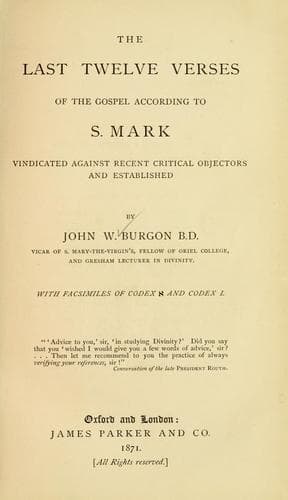
The Last Twelve Verses of the Gospel According to S. MarkBurgon, John William
Religion
The Last Twelve Verses of the Gospel According to S. Mark
Burgon, John William
Bible. Mark XVI, 9-20 -- Criticism, Textual
IV. and V. But now, while the remarks of Eusebius are yet fresh in the
memory, the reader is invited to recall for a moment what the author of
the “Homily on the Resurrection,” contained in the works of Gregory of
Nyssa (above, p. 39), has delivered on the same subject. It will be
remembered that we saw reason for suspecting that not
SEVERUS OF ANTIOCH, but
HESYCHIUS OF JERUSALEM,
(both of them writers of the vith century,) has the better claim to the
authorship of the Homily in question,(97)—which, however, cannot at all
events be assigned to the illustrious Bishop of Nyssa, the brother of
Basil the Great. “In the more accurate copies,” (says this writer,) “the
Gospel according to Mark has its end at ‘for they were afraid.’ In some
copies, however, this also is added,—‘Now when He was risen early the
first day of the week, He appeared first to Mary Magdalene, out of whom He
had cast seven devils.’ This, however, seems to contradict to some extent
what we before delivered; for since it happens that the hour of the night
when our SAVIOUR rose is not known, how does it come to be here written
that He rose ‘early?’ But the saying will prove to be no ways
contradictory, if we read with skill. We must be careful intelligently to
introduce a comma after, ‘Now when He was risen:’ and then to
proceed,—‘Early in the Sabbath He appeared first to Mary Magdalene:’ in
order that ‘when He was risen’ may refer (in conformity with what Matthew
says) to the foregoing season; while ‘early’ is connected with the
appearance to Mary.”(98)—I presume it would be to abuse a reader’s
patience to offer any remarks on all this. If a careful perusal of the
foregoing passage does not convince him that Hesychius is here only
reproducing what he had read in Eusebius, nothing that I can say will
persuade him of the fact. The _words_ indeed are by no means the same; but
the sense is altogether identical. He seems to have also known the work of
Victor of Antioch. However, to remove all doubt from the reader’s mind
that the work of Eusebius was in the hands of Hesychius while he wrote, I
have printed in two parallel columns and transferred to the Appendix what
must needs be conclusive;(99) for it will be seen that the terms are only
not identical in which Eusebius and Hesychius discuss that favourite
problem with the ancients,—the consistency of S. Matthew’s ὀψὲ τῶν
σαββάτων with the πρωί of S. Mark.
Public-domain text, read in full here on John Shaqi.
Reviews
Reviews
No reviews yet
Be the first to share your thoughts on this work.
Join the Discussion
Join the discussion
Sign in to leave a comment or review.
Sign InorCreate an account