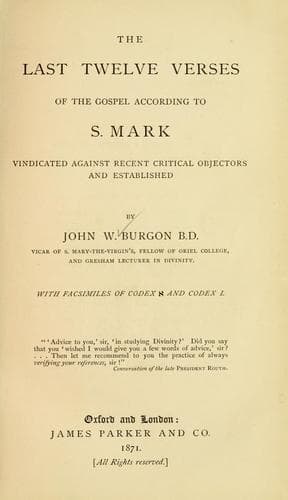
The Last Twelve Verses of the Gospel According to S. Mark — John Shaqi
The Last Twelve Verses of the Gospel According to S. MarkBurgon, John William
Religion
The Last Twelve Verses of the Gospel According to S. Mark
Burgon, John William
Bible. Mark XVI, 9-20 -- Criticism, Textual
pretend that it is in _any_ sense the testimony of Jerome which we are
here presented with; that Jerome is one of those Fathers “who, even though
they copied from their predecessors, were yet competent to transmit the
record of a fact,”(95)—is entirely to misunderstand the case. The man who
translates,—not adopts, but _translates_,—_the problem_ as well as its
solution: who deliberately asserts that it emanated from a Lady inhabiting
the furthest extremity of Gaul, who nevertheless was demonstrably not its
author: who goes on to propose as hers question after question _verbatim
as he found them written in the pages of Eusebius_; and then resolves them
one by one _in the very language of the same Father_:—such a writer has
clearly conducted us into a region where his individual responsibility
quite disappears from sight. We must hear no more about Jerome, therefore,
as a witness against the genuineness of the concluding verses of S. Mark’s
Gospel.
On the contrary. Proof is at hand that Jerome held these verses to be
genuine. The proper evidence of this is supplied by the fact that he gave
them a place in his revision of the old Latin version of the Scriptures.
If he had been indeed persuaded of their absence from “_almost all the
Greek codices_,” does any one imagine that he would have suffered them to
stand in the Vulgate? If he had met with them in “_scarcely any copies of
the Gospel_”—do men really suppose that he would yet have retained them?
To believe this would, again, be to forget what was the known practice of
this Father; who, because he found the expression “without a cause”
(εἰκή,—S. Matth. v. 22,) only “in certain of his codices,” but not “in the
true ones,” _omitted_ it from the Vulgate. Because, however, he read
“righteousness” (where we read “alms”) in S. Matth. vi. 1, he exhibits
“_justitiam_” in his revision of the old Latin version. On the other hand,
though he knew of MSS. (as he expressly relates) which read “works” for
“children” (ἔργων for τέκνων) in S. Matth. xi. 19, he does not admit that
(manifestly corrupt) reading,—which, however, is found both in the Codex
Vaticanus and the Codex Sinaiticus. Let this suffice. I forbear to press
the matter further. It is an additional proof that Jerome accepted the
conclusion of S. Mark’s Gospel that he actually quotes it, and on more
than one occasion: but to prove this, is to prove more than is here
required.(96) I am concerned only to demolish the assertion of
Tischendorf, and Tregelles, and Alford, and Davidson, and so many more,
concerning the testimony of Jerome; and I have demolished it. I pass on,
claiming to have shewn that the name of Jerome as an adverse witness must
never again appear in this discussion.
Public-domain text, read in full here on John Shaqi.
Reviews
Reviews
No reviews yet
Be the first to share your thoughts on this work.
Join the Discussion
Join the discussion
Sign in to leave a comment or review.
Sign InorCreate an account